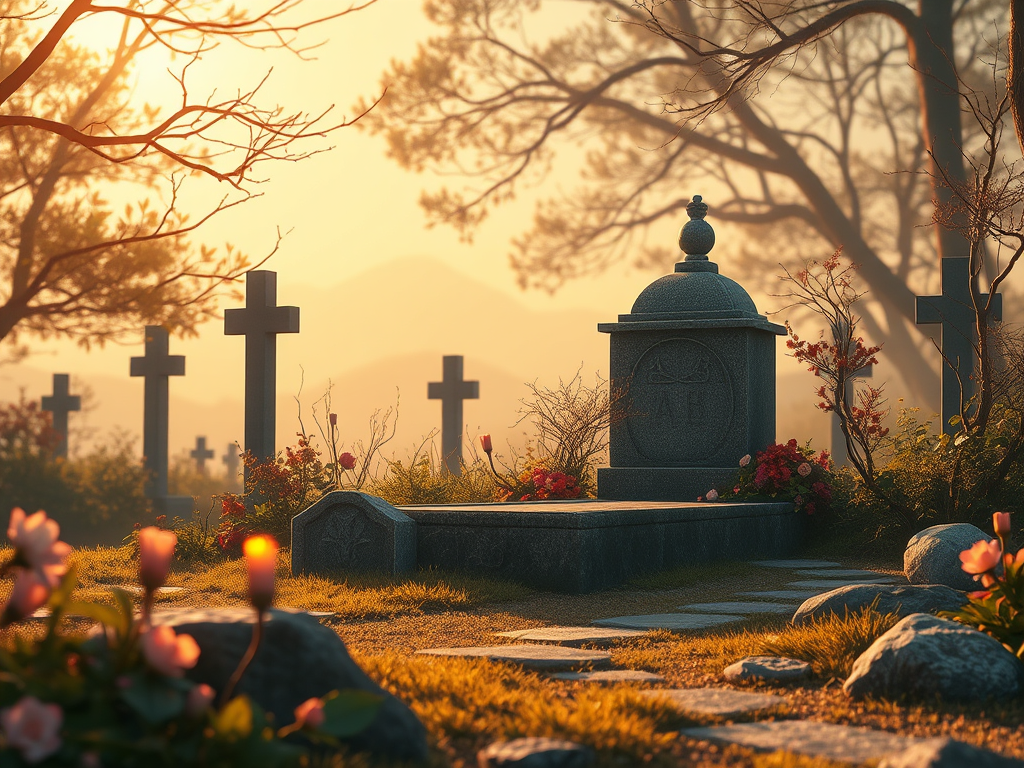
— The Meihua Verdict on the Afterlife Residence
Prologue|The Myth of the “Final Resting Place”
What is a grave?
When the body returns to the earth, consciousness moves beyond the physical plane.
Yet humanity insists on building stone chambers, treating them as the permanent address of the departed.
We light incense, offer flowers, and speak to the stone as if someone is listening inside.
But let’s ask honestly:
Is anyone really there?
The Meihua Xin-Yi divination gives the hexagram Mountain over Earth — “Peeling” (剝),
symbolizing the dissolution of outer forms and the futility of attachment to them.
“Peeling — the soft consumes the rigid, until the form is lost.”
The more we cling to form, the further we stray from truth.
A grave, then, is not a spirit’s home — it is a symbol of remembrance,
a physical beacon through which the living express devotion.
Its value lies not in what dwells beneath, but in what it awakens above — in us.
Chapter I|The Soul Does Not Dwell in Stone
After death, consciousness migrates through vibrational layers — what ancient seers called the “planes.”
These are not spatial regions but frequency domains.
The soul, being light and wave, cannot be confined by soil or granite.
The Meihua Xin-Yi hexagram Wind over Heaven – “Nourishment” (小畜) represents this:
“The wind ascends and returns to Heaven.”
The soul is wind — moving, unseen, continuous.
The grave is simply a human transmitter, a symbolic radio tower for remembrance.
But the transmission works anywhere:
When the mind is clear, every place becomes sacred ground.
Chapter II|The Psychological Function of the Grave
Still, the grave serves an undeniable social and emotional role.
It anchors memory.
It gives mourners a tangible interface to process grief and to honor connection.
The Meihua hexagram Earth over Mountain – “Modesty” (謙) speaks of this humility:
“To be great without seeking a name.”
The power of a grave lies not in its grandeur but in its sincerity.
It is not a house for the dead — it is a dojo for the living,
a training ground for gratitude and continuity.
Chapter III|Why the Wealthy Build Palatial Tombs
Across East Asia — in China, Taiwan, Hong Kong —
graves are built not only for mourning, but for feng shui.
The tomb’s orientation, alignment with dragon lines, and terrain
are believed to determine the family’s fortune for generations.
This belief originates in the ancient doctrine of Yin House Feng Shui,
where the ancestor’s tomb serves as an energy conduit for the living lineage.
In Meihua terms, the hexagram Earth over Thunder – “Return” (復) appears:
“Returning to the root, the source revives.”
Thus, the act of building a magnificent grave can be seen as
an attempt to link the lineage’s “ancestral current” back to heaven and earth.
Yet, as the oracle warns:
“Even if the form is perfect, if the heart is impure, the dragon will not flow.”
Feng shui without virtue becomes superstition.
Chapter IV|The Modern Shift: From Stone to Spirit
In divinatory sequence, the grave’s archetype evolves
from Heaven and Earth Divided (否) to Fire over Wind – “The Cauldron” (鼎) —
a sign that old structures dissolve, giving rise to new ritual forms.
Indeed, we now witness a quiet revolution:
tree burials, ocean scattering, digital memorials, virtual shrines.
The sacred has migrated from matter to memory.
This is not cultural decay — it is conscious evolution.
Humanity is shifting from the era of form to the era of frequency.
The grave is no longer underground — it lives in the cloud of remembrance.
Chapter V|The Verdict: Not a Necessity, But an Expression
So, is a grave necessary?
The Meihua verdict: No.
A grave is not a metaphysical necessity — it is an expression of devotion.
Its sacredness depends not on stone, but on the intention that built it.
“The grave is not a home, but it can become a sanctuary of the heart.”
The final hexagram Fire over Heaven – “Possession in Great Measure (大有)” says:
“That which you possess, return to Heaven.”
True reverence is not found in granite or marble,
but in the living act of remembrance — the quiet gratitude we breathe every day.
To honor the dead,
live in a way that reflects their light.
Appendix|If You Choose “No Grave,” What Then?
If one discards the notion of a physical grave, Meihua guidance suggests:
- Set aside a quiet day each year to recall your ancestors.
- Offer light or incense anywhere — intention bridges distance.
- Transform remembrance into daily gratitude and kindness.
“True offering is not ritual to the dead,
but awakening of the living to the light within.”
The highest tomb is built not on land,
but in the soul that remembers.
✶ Meihua Final Oracle
“Mountains fall, valleys form, stones vanish — yet the heart remains.
As long as there is light in the heart’s tomb, the ancestors live within.”
The grave is not made of earth, but of awareness.
Form fades — remembrance endures.
コメントを残す