Introduction|What Makes the Goma Ritual So Unique?
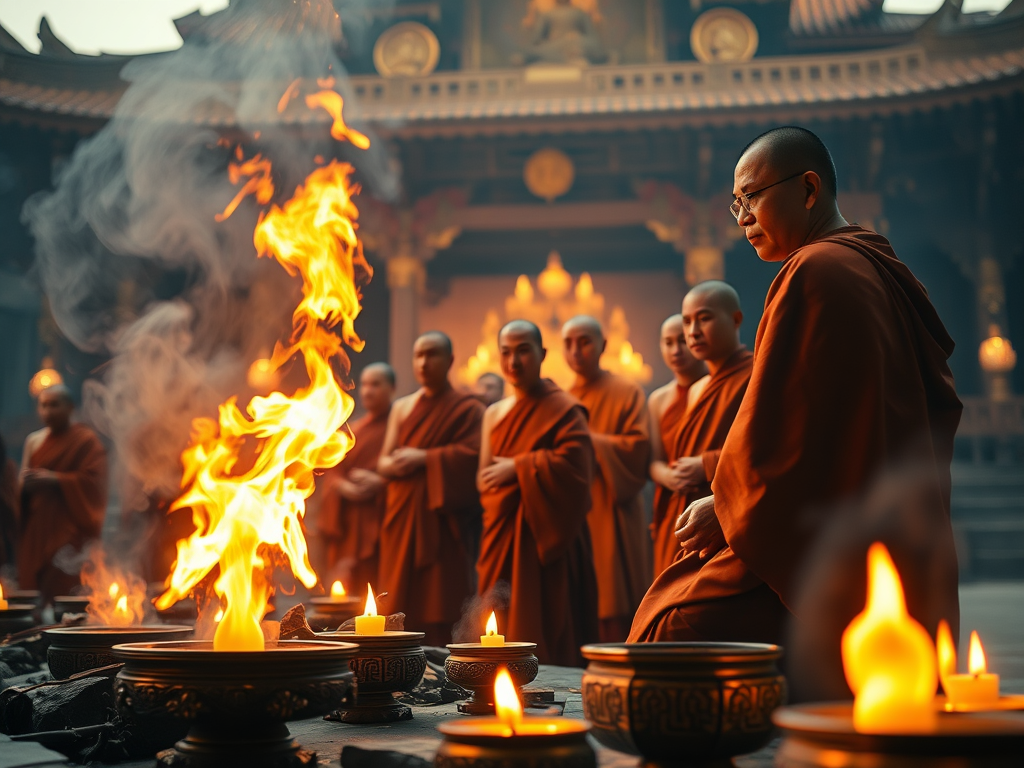
Within Japanese esoteric Buddhism, the Goma fire ritual and the oil-offering rite (Yokuyu Kito) are among the most striking ceremonies. Monks chant mantras, feed wooden sticks into the sacred fire, and invoke divine protection. The spectacle is so intense that many think, “Surely this must work.”
But in practice?
- Some see no changes even after investing in costly rituals.
- Others experience dramatic life shifts after a modest ceremony.
- And many still ask, “What exactly is the true purpose of Goma?”
This article applies Plum Blossom Divination (Meihua Yi) to uncover the symbolic meaning of these rituals and reveal what truly determines their effectiveness.
Chapter 1|The Nature and Purpose of Goma & Oil-Offering Rituals
- Goma Fire Ritual: A purification rite from Shingon and Tendai traditions.
- Oil-Offering Ritual (Yokuyu): An esoteric rite using herbal oils to invoke blessings.
Their aims generally fall into five categories:
- Purification & Exorcism – dispelling misfortune, cleansing karmic residue
- Fortune & Wish Fulfillment – wealth, career growth, prosperity
- Healing & Protection – health restoration, removal of spiritual disturbances
- Ancestral/Karmic Release – family karma clearing, ancestral appeasement
- Higher Spiritual Alignment – synchronizing the soul with deity energy
Chapter 2|Plum Blossom Divination: Do They Truly Work?
Divination Theme: Are Goma and oil-offering rituals genuinely effective?
- Primary Hexagram: 火風鼎 (Fire over Wind / The Cauldron)
→ When the “vessel” is ready, the energy is fully received. - Changing Hexagram: 山沢損 (Mountain over Lake / Loss)
→ If unprepared, much of the benefit is lost.
Conclusion:
Effectiveness depends less on the ritual’s raw power and more on the alignment between the recipient’s soul-theme and the ritual’s symbolic intent.
Chapter 3|Effectiveness Ranking
| Rank | Ritual Type | Symbolic Effectiveness | Notes |
|---|---|---|---|
| 1 | Oil-Offering Ritual | ★★★★★ | Strong resonance with deep soul layers |
| 2 | Grand Goma Ritual | ★★★★☆ | Best performed 1–2 times yearly |
| 3 | Small Goma Ritual | ★★★★☆ | Effective for personal tuning, less reproducible |
| 4 | Ancestral/Karmic Release Goma | ★★★☆☆ | Powerful when aligned |
| 5 | Business Prosperity Goma | ★★☆☆☆ | Risk of reversal if desire-driven |
Chapter 4|Case Studies
- Case 1: Woman relieved of insomnia after oil ritual
Hexagram: 坎為水 → 火水未済
Soul-theme and deity resonance aligned → insomnia resolved within a month. - Case 2: Executive promotion after grand Goma
Hexagram: 雷火豊 → 風天小畜
Soul-theme aligned with leadership and integration → promoted within 3 months. - Case 3: Business losses after prosperity ritual
Hexagram: 沢火革 → 坤為地
Soul-theme clashed with material desires → over-ritualization led to decline.
Chapter 5|How to Maximize Results
- Align your soul-theme with the ritual’s symbolic intent (consult divination first)
- Focus on one clear intention (avoid multi-purpose prayers)
- Choose the appropriate deity (Fudō Myō-ō for protection, Yakushi Nyorai for healing, Kannon for compassion)
- Prioritize quality over quantity (better once or twice a year than frequent shallow rites)
Conclusion|Goma as “The Ignition of Symbolic Power”
Goma rituals are not about asking the divine, but about igniting symbolic alignment between your soul and the chosen deity.
- With alignment, reproducibility is remarkably high.
- Without alignment, misfortune can just as easily be triggered.
In essence, Goma works not because “fire always works,” but because the fire can either ignite—or fail to ignite—the correct symbolic resonance.
コメントを残す