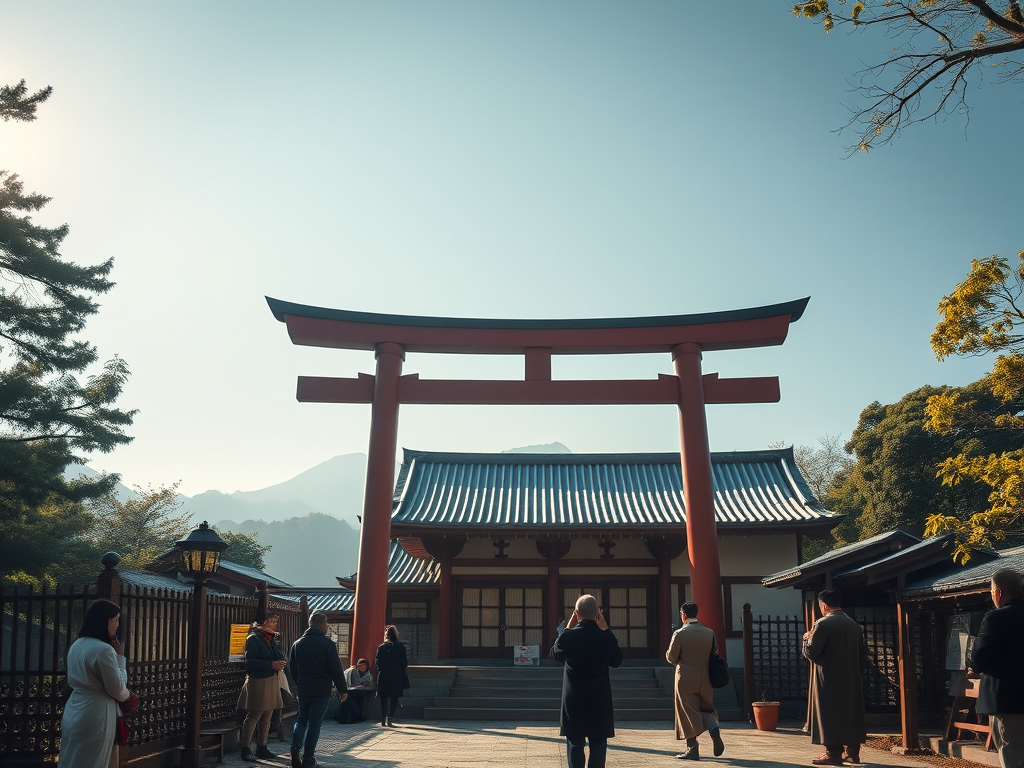
Prologue|Does Shrine Prayer Really Improve Your Luck?
Every year during New Year’s season, shrines overflow with worshippers.
Great Purification rites, misfortune warding, matchmaking blessings, safe childbirth prayers… Reservations for rituals are packed everywhere.
But one nagging question always arises:
- “Does it really work?”
- “Is an expensive ritual more effective than a standard one?”
- “Do some shrines have stronger results than others?”
In this article, I’ll put these doubts to rest.
Using Plum Blossom Divination, I analyzed the symbolic results of shrine rituals—revealing their reproducibility with honesty and a touch of humor.
Chapter 1|The World of Shrine Rituals
Shinto rituals generally fall into five categories:
- Great Purification (Ōharae)
- Large-scale rites held twice a year to cleanse sins and impurities.
- Exorcisms & Directional Protection
- Performed to ward off bad luck during “yakudoshi” years or from unlucky compass directions.
- Matchmaking & Love
- For attracting a partner or deepening marital harmony.
- Safe Childbirth & Fertility
- To bless mothers during pregnancy and support healthy growth for children.
- Good Fortune & Wish Fulfillment
- For wealth, promotions, exam success, and other worldly desires.
Interestingly, many shrines focus less on “instant effects” and more on continuity of faith.
In other words, those who return year after year experience stronger symbolic alignment than one-time visitors.
Chapter 2|Divination Test: Do Shrine Prayers Work?
Divination Question:
“Do shrine rituals actually have real effects?”
- Primary Hexagram: Wind over Earth (觀) → “Inner reflection and harmony enhance effectiveness.”
- Changing Hexagram: Fire over Water (未濟) → “Formalities alone fail to align the symbols.”
Conclusion:
Shrine rituals are most effective only when the soul’s theme aligns with the symbolic intent of the prayer.
For example:
- Exorcism rituals synchronize with misfortune years → high effectiveness.
- Lottery prayers rarely align symbolically → negligible effect.
Chapter 3|Effectiveness Ranking of Shrine Rituals
| Rank | Ritual Type | Symbolic Effect | Notes |
|---|---|---|---|
| 1 | Great Purification | ★★★★★ | Best performed twice a year; collective rituals amplify energy. |
| 2 | Exorcism & Directional Protection | ★★★★☆ | Strong for avoiding misfortune when aligned. |
| 3 | Safe Childbirth | ★★★★☆ | Closely linked with child-related symbolism. |
| 4 | Matchmaking | ★★★☆☆ | Highly effective when aligned with soul themes. |
| 5 | Wealth & Lottery | ★☆☆☆☆ | Rarely moves unless symbolic match is exact. |
Chapter 4|Does a More Expensive Ritual Work Better?
In short: No.
Plum Blossom Divination shows that results depend on three factors:
- Degree of symbolic alignment
- Skill of the ritual practitioner
- Vibrational quality of the shrine environment
Even a ¥100,000 ritual is ineffective if symbols are misaligned.
Meanwhile, a ¥5,000 ritual can work instantly if aligned.
That said, high-cost rituals often feature higher ritual quality—so if aligned, reproducibility does increase.
Chapter 5|Real-Life Cases
- Case 1|Man avoids an accident through exorcism
- Hexagram: Thunder over Heaven (大壯) → Wind over Thunder (益).
- Aligned perfectly with misfortune-year symbolism.
- Within a week of the ritual, narrowly avoided a traffic accident.
- Case 2|Marriage after matchmaking prayer
- Hexagram: Mountain over Lake (損) → Fire over Wind (鼎).
- Soul theme: family and love.
- Within six months, met ideal partner and married.
- Case 3|Lottery prayer backfires
- Hexagram: Lake over Earth (萃) → Water doubled (坎).
- Soul theme: service and healing.
- Lottery win never came; debts increased instead.
- A textbook case of symbolic misalignment.
Chapter 6|How to Maximize the Power of Shrine Rituals
- Choose the right shrine for your purpose
- Matchmaking → Izumo-related shrines; Exorcism → Great Purification shrines.
- Align timing with symbolism
- Use Plum Blossom Divination to choose ritual dates.
- Focus on one wish only
- Multiple requests create symbolic “signal interference.”
- Don’t neglect aftercare
- Align daily habits with the symbolic intent of the ritual.
Final Chapter|Rituals Are Techniques of Symbolic Alignment
Plum Blossom Divination reveals:
Rituals are not mere “requests,” but a practice of synchronizing soul themes with sacred symbolism.
When aligned, even a small prayer can trigger major shifts in reality.
When misaligned, even the most elaborate ritual won’t move a thing.
Comparative Note|Shinto Rituals vs. Western Prayers and Spiritual Ceremonies
When comparing Shinto shrine rituals to Western practices such as Catholic Mass, Protestant prayer circles, or New Age healing ceremonies, several parallels and contrasts emerge:
- Shared Core Principle
Both emphasize alignment with the divine order.- Shinto: synchronizing with kami and the symbolic flow of nature.
- Christianity: invoking God’s grace through liturgy and intercession.
- Symbolic Mediums
- Shinto rituals: offerings, purification rites, and ancient chants.
- Western churches: sacraments (bread, wine), hymns, and scripture.
- Effectiveness Factors
Plum Blossom Divination suggests:- Rituals work best when the participant’s soul theme matches the symbolic content.
- In Christianity, this parallels the idea that faith and intention are the “channels” through which grace operates.
- In New Age or modern energy healing, effectiveness often depends on vibrational resonance—similar to Shinto’s emphasis on “harmonizing with the right symbolic field.”
- Differences in Continuity
- Shinto shrines emphasize annual or seasonal repetition—returning every year strengthens symbolic alignment.
- Western churches stress weekly worship and lifelong faith as continuity.
- The Universal Takeaway
Across cultures, rituals—whether at a Shinto shrine, a Christian cathedral, or a New Age gathering—become effective not simply because of ritual formality, but because of symbolic alignment, faith, and consistent practice.
コメントを残す