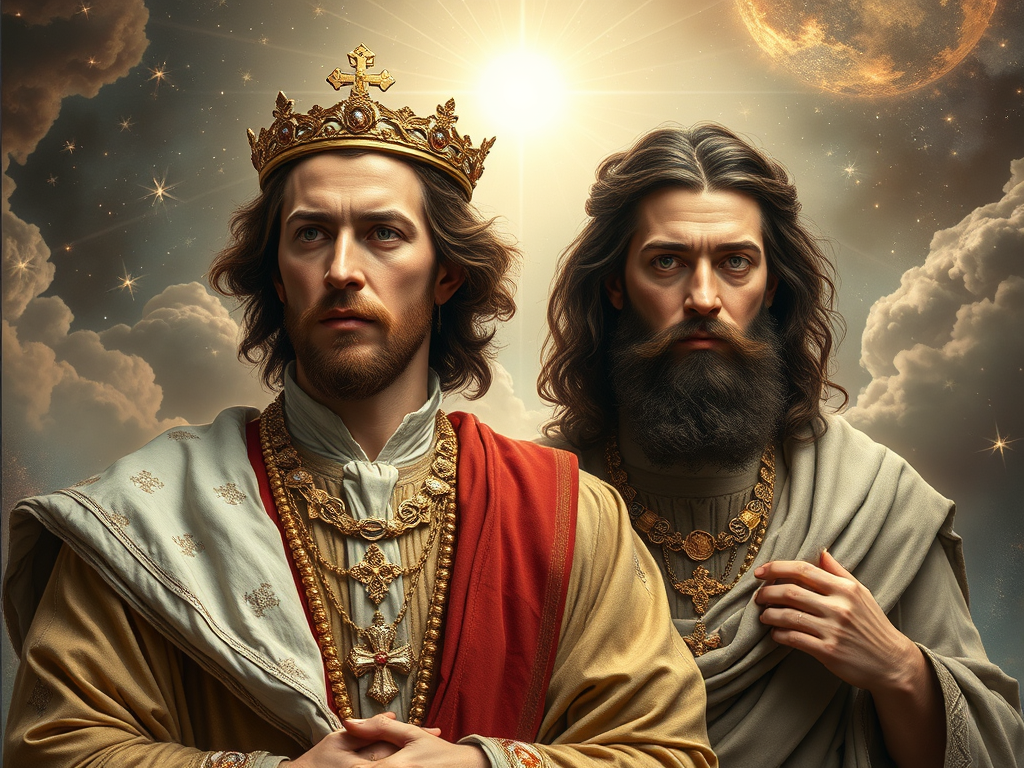
The Concept of a Consciousness Continuum That Transcends Time
A Meihua Xin-Yi Interpretation
Introduction — Why Is Saint Germain So Difficult to Pin Down?
In 18th-century Europe, a mysterious figure appeared among royalty, philosophers, alchemists, and mystics:
the Count of Saint Germain.
He seemed ageless.
He spoke of centuries past as personal memory.
He mastered languages, arts, politics, and esoteric sciences with unnatural ease.
And most curiously, his death was reported multiple times—yet never conclusively confirmed.
Within esoteric traditions, a provocative question has persisted:
Was Saint Germain the same being as the Apostle John?
At first glance, this appears to be speculative mysticism or reincarnation lore.
However, through the lens of Meihua Xin-Yi, this question becomes structural rather than sensational.
This article explores:
- The symbolic common ground between Saint Germain and the Apostle John
- Why reincarnation theory alone fails to explain the parallels
- The idea of a consciousness continuum—an awareness that persists beyond time, identity, and form
1. The Apostle John as an Anomalous Figure
Among the disciples of Jesus, John stands apart.
He is described as:
- “the disciple whom Jesus loved”
- the longest-living apostle
- the author of the Gospel of John and Revelation
- a figure rumored not to die
Most importantly, the texture of John’s writings is unlike that of the other apostles.
The Gospel of John is not primarily moral or legal.
It is ontological.
- Not commandments, but Logos
- Not rules, but light and being
- Not historical narration, but consciousness language
From a Meihua Xin-Yi perspective, John is not a man of action but a holder of the central symbolic axis.
2. Saint Germain as a Figure Outside of Time
Saint Germain exhibits a strikingly similar pattern.
Accounts consistently describe him as:
- unaffiliated with nation or religion
- origin unknown
- untraceable within linear chronology
- capable of assuming roles without identity attachment
In Meihua Xin-Yi symbolism, this reflects a state where:
the body moves through time,
but the central phase of consciousness remains unchanged
This is not ordinary longevity.
It is the behavior of awareness that is no longer governed by linear time.
3. Why Reincarnation Theory Falls Short
Many attempt to explain the Saint Germain–John connection through reincarnation.
However, reincarnation alone cannot account for several key features:
- continuity of memory
- absence of ego regression
- lack of a re-learning or re-training phase
In Meihua Xin-Yi terms, this is not the pattern of a soul that “starts over.”
It is the pattern of:
a continuous center of awareness
that never loses coherence
This is what we call a consciousness continuum.
4. What Is a Consciousness Continuum?
A consciousness continuum is a state in which:
- bodies change
- names change
- eras change
- roles change
but the central subjective awareness remains uninterrupted.
In Meihua Xin-Yi, this is expressed as:
“The center remains; the forms transform.”
Within this state:
- death is a phase transition, not an endpoint
- memory is held in the field of awareness, not the brain
- time is perceived as layered, not linear
To observers embedded in linear time, such a being appears immortal, elusive, or mythical.
This explains why:
- John was rumored not to die
- Saint Germain was repeatedly reported dead—yet reappeared
They are observations of the same structural phenomenon.
5. Revelation and Saint Germain: A Shared Function
The Book of Revelation is often read as prophecy or apocalyptic warning.
Structurally, however, it is a map of consciousness transformation across levels.
Saint Germain, in esoteric history, appears repeatedly at moments of civilizational transition:
- advising kings
- warning political systems
- introducing symbolic knowledge
In Meihua Xin-Yi, this role corresponds to:
the central stabilizer who appears at the moment before a structural shift
Both John and Saint Germain function not as rulers, but as threshold witnesses—
figures who remain centered while the surrounding system transforms.
6. Conclusion — Same Person, or Same Phase?
So, was Saint Germain the same being as the Apostle John?
Meihua Xin-Yi offers a precise answer:
Not provably the same historical person.
But very likely the same consciousness continuum.
This is not identity of body, soul fragment, or narrative biography.
It is identity of phase—
a continuous central awareness expressing itself through different historical forms.
Final Reflection — Why This Idea Resonates Now
This question resonates today because modern humans are beginning to sense something profound:
- identity is not confined to biography
- time is not as rigid as assumed
- consciousness may not reset as completely as once believed
Saint Germain and the Apostle John are extreme examples—but they point to a universal inquiry:
How continuous can consciousness become?
And how free from time might awareness ultimately be?
This is not merely about saints or mystics.
It is about the latent potential of human consciousness itself.
コメントを残す