From Vision to Neural Rewriting
A Meihua Xin-Yi Interpretation
Introduction — The Misconception of the Ten Commandments as Mere Laws
The story is familiar.
Moses ascends Mount Sinai.
God speaks.
Stone tablets are carved.
The Ten Commandments are delivered to humanity.
This narrative is usually understood as a transfer of rules—
divine speech translated into moral law.
Yet this interpretation leaves a crucial question unanswered:
Why did these words shape human civilization so profoundly, for so long?
From the perspective of Meihua Xin-Yi, an ancient system of symbolic and structural interpretation, what occurred on Mount Sinai was not simply the reception of verbal commandments.
It was a visionary event—
one that reconfigured Moses’ perceptual and neural structure itself.
This article explores:
- What Moses actually saw
- Why the experience could not remain personal
- How a vision becomes law when consciousness is neurologically overwritten
1. What “Seeing” Means in Meihua Xin-Yi
In Meihua Xin-Yi, “seeing” does not refer to visual imagery alone.
To see means:
- to apprehend structure directly,
- to grasp reality as an integrated pattern,
- to internalize that pattern so completely that it becomes non-negotiable.
This is not observation.
It is structural perception.
In modern terms, we might say:
the perceptual framework itself is rewritten.
Moses did not receive information.
He underwent a state change in consciousness.
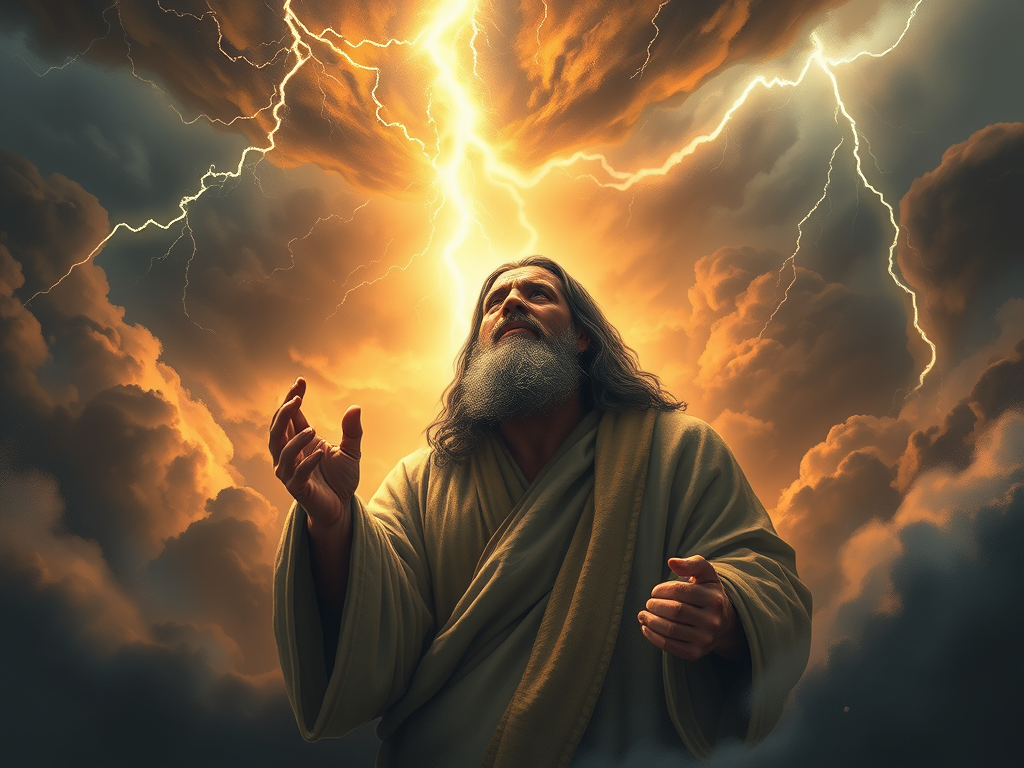
2. Thunder, Fire, and Cloud — Symbolism of Neural Overload
The biblical description of Mount Sinai is dramatic:
- thunder
- lightning
- thick cloud
- fire
- violent trembling
Read literally, these appear as theatrical divine manifestations.
Read symbolically, they map precisely onto extreme altered states of consciousness.
In Meihua Xin-Yi symbolism:
- Thunder → sudden large-scale neural synchronization
- Fire → intense influx of cognitive-emotional energy
- Cloud → suppression of ordinary sensory processing
- Trembling → destabilization of the egoic self-model
In other words:
Moses’ usual identity framework temporarily collapsed,
allowing a deeper structural layer of reality to be perceived.
This is not metaphorical.
It is a description of neural reorganization under visionary stress.
3. The Ten Commandments as Fixed Vision, Not Moral Instruction
This leads to a crucial reframing.
The Ten Commandments are typically read as:
- ethical rules
- divine prohibitions
- social regulations
But from a Meihua Xin-Yi perspective, they are not instructions.
They are the externalized imprint of an internal vision.
For example:
- “You shall not murder.”
- “You shall not steal.”
- “You shall not bear false witness.”
These are not conclusions reached through reasoning.
They reflect a prior realization:
If these boundaries collapse, the world itself collapses.
The commandments feel absolute not because they are authoritarian,
but because no alternative structure remains visible once the vision has been seen.
4. Why Stone Tablets? The Symbol of Irreversibility
Why were the commandments carved into stone?
Stone is:
- rigid
- resistant to alteration
- enduring across time
In Meihua Xin-Yi symbolism, stone represents a structure that has lost plasticity.
This mirrors what happened internally.
Once Moses perceived the foundational constraints of human coexistence,
his consciousness could not return to a previous state.
The stone tablets symbolize:
a neural configuration that has become fixed.
They are not sacred because they were written by God,
but because they represent an irreversible perceptual threshold.
5. When Vision Becomes Law — The Inherent Risk
Here lies the paradox.
A visionary experience is alive, dynamic, and contextual.
A law is static, universal, and enforceable.
When Moses’ vision was transmitted to a collective, a transformation occurred:
- vision → doctrine
- perception → obedience
- structure → authority
In Meihua Xin-Yi, this is described as:
the death of the symbol.
The commandments retained power because they originated in genuine structural insight.
But the moment they became absolute, they also lost their capacity for renewal.
This tension is not a failure—it is unavoidable.
6. Conclusion — What Moses Truly Saw
So what did Moses actually see?
From a Meihua Xin-Yi perspective:
He did not hear divine speech.
He perceived the minimum structural conditions under which human reality can exist.
These conditions are not cultural preferences.
They are thresholds.
Cross them, and the social-psychological world destabilizes.
That vision was encoded as law not because humanity was untrustworthy,
but because no softer medium could preserve it.
Final Reflection — Why This Matters Now
The Ten Commandments are not ancient religious relics.
They are:
an early attempt to preserve a catastrophic insight
into human cognitive and social limits.
Today, as technology, power, and abstraction accelerate,
humanity once again approaches those limits.
What Moses saw was not God in the sky.
It was the structural line beyond which coherence fails.
And that line, now as then, remains visible
only to those willing to undergo a profound transformation of perception.
コメントを残す