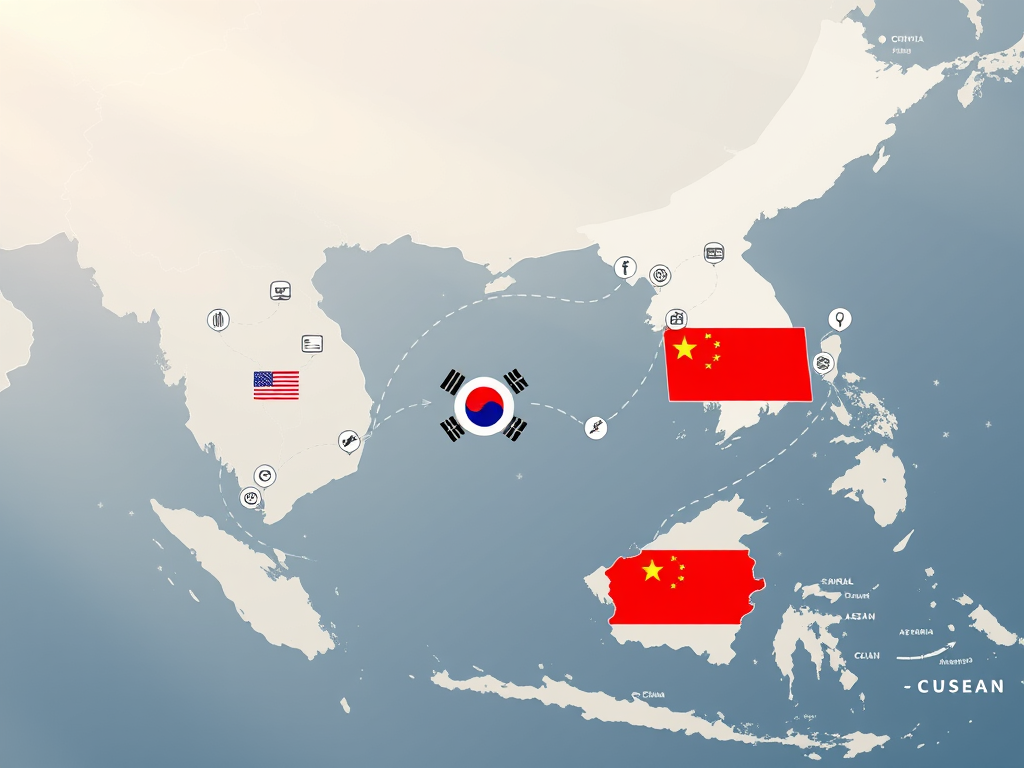
Part XIII: South Korea & Southeast Asia 2026–2035 – Innovation, Tensions, and Shifting Alliances
The Question
South Korea and Southeast Asia are regions of rapid change and vulnerability:
- Will South Korea’s role in U.S.-China rivalry destabilize its future?
- Can Southeast Asia maintain growth amid climate change, great power pressure, and internal divisions?
- Which nations will emerge stronger, and which may falter?
Hexagram Reading
- Present Hexagram: Wind over Mountain (Xian – Influence / Attraction) → connections, persuasion, sensitivity.
- Future Hexagram: Heaven over Fire (Da Xu – Great Restraint) → controlled strength, patience, and potential breakthroughs through discipline.
Interpretation
Xian (Influence):
- The region today is defined by outside influence—U.S., China, Japan competing for sway.
- Economic interdependence pulls nations in multiple directions.
Da Xu (Great Restraint):
- The future will demand patience, self-control, and careful positioning.
- Acting too rashly risks collapse; waiting wisely allows breakthroughs.
Prediction
South Korea (2026–2035)
- Short-Term (2026–2027):
- Domestic polarization continues over North Korea policy, U.S. alliance, and economic inequality.
- Technological innovation (AI, semiconductors, biotech) remains world-class.
- Medium-Term (2028–2030):
- A North Korea crisis—either political collapse or sudden escalation—reshapes the peninsula.
- South Korea strengthens ties with the U.S. but cautiously manages China.
- Long-Term (2031–2035):
- Baekhwa I-Ching shows restraint leading to growth: South Korea emerges as a middle-power broker, balancing diplomacy while retaining tech dominance.
Southeast Asia (2026–2035)
- Short-Term (2026–2027):
- ASEAN struggles with unity; Myanmar crisis and South China Sea disputes highlight divisions.
- Vietnam, Indonesia, and Philippines rise as key U.S. partners.
- Medium-Term (2028–2030):
- Climate disasters (typhoons, floods) test resilience.
- Regional economies boom, but inequality widens; corruption challenges persist.
- Long-Term (2031–2035):
- Baekhwa I-Ching shows controlled strength: Southeast Asia becomes a strategic hub, balancing U.S. and China.
- Indonesia rises as the natural leader of ASEAN, while Singapore and Vietnam retain influence.
Baekhwa I-Ching’s Message
Both South Korea and Southeast Asia face external pressures and internal fragility.
The oracle warns: “To move too fast invites ruin; to restrain is to grow.”
Their success depends on patience, discipline, and strategic balance.
Reader’s Question
Will South Korea and Southeast Asia remain pawns in the great power game—or transform into masters of their own destiny?
コメントを残す