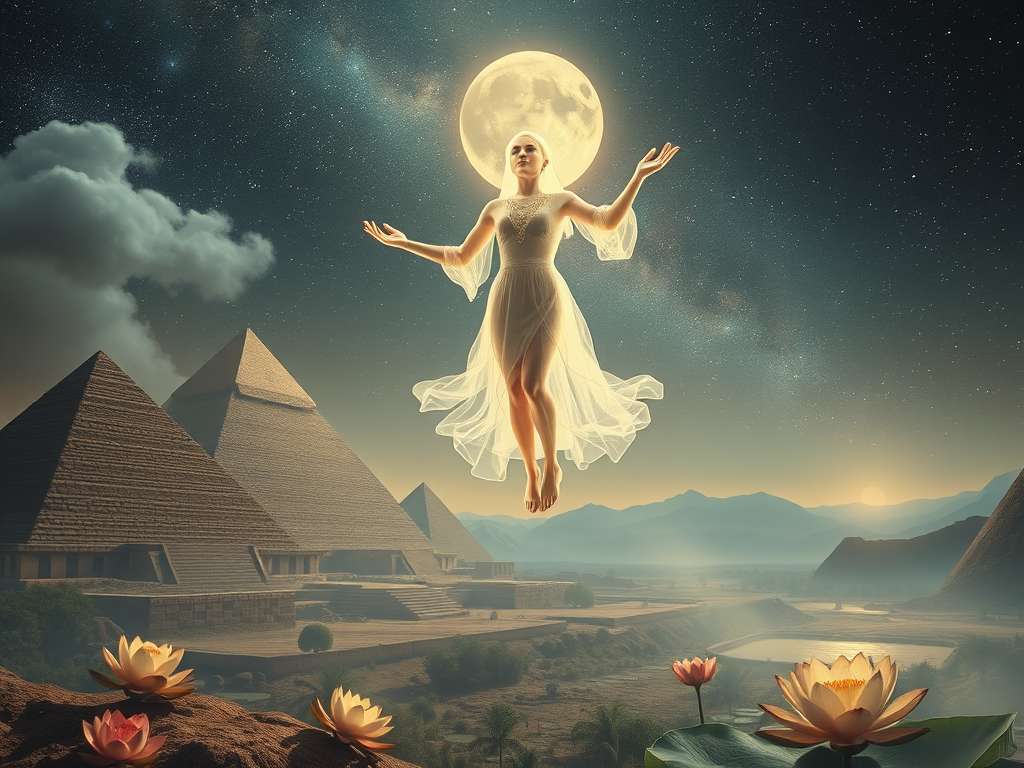
Prologue|Why Revisit “Out-of-Body Experiences” Now?
Meditation, mindfulness, and spiritual practices have gone mainstream. Bookstores and social feeds brim with “OBE” and “astral travel.” Why are we so drawn to experiences that seem to leap beyond the physical body?
Science often files OBEs under “hallucination” or “neural phenomena.” Yet first-person reports are strikingly consistent across cultures and faiths. In this essay, we’ll turn to Plum Blossom Yi (梅花心易)—an East Asian divinatory method rooted in the I Ching—to probe the reality, symbolism, and implications of OBEs with care.
Chapter 1|A Brief History and Cultural Backdrop of OBEs
“Out-of-body experience (OBE)” may conjure YouTube thumbnails or occult magazines today, but humans across eras have claimed such experiences in astonishing numbers.
Ancient Egypt and the Ka
Egyptians held that alongside the body resided a spiritual double, the ka. Funerary art often depicts a translucent “second self” watching the body at rest. In other words, 3,000 years ago Egyptians already assumed: “of course the soul can step out.”
Indian Philosophy and the Subtle Body
Classical Indian thought distinguishes the gross body (sthūla śarīra) from the subtle body (sūkṣma śarīra). Through meditation, adepts could let the subtle body roam—essentially an ancient analogue of OBEs—accessing non-ordinary realms and divine strata.
Medieval Europe’s “Soul Flights”
In Christian Europe, “nocturnal flights” were cast as witchly sabbaths or demonic pacts and could invite inquisitorial scrutiny. A farmer’s wife who testified, “An angel led me through the skies as I slept,” might, by modern lights, be offering a textbook OBE report—though in her time it risked charges of heresy.
Modern Research and the Monroe Institute
Fast-forward: Robert Monroe systematized OBE induction via binaural beats, founding the Monroe Institute (U.S.). Participants explore “Focus levels” (Focus 10, 21, 27, etc.), reporting contact with afterlife transit zones and guide-like presences. Monroe’s framework popularized the very phrase “out-of-body experience.”
Reading History with Plum Blossom Yi
Query: “Across human history, were OBE reports genuine or illusory?”
Hexagram: Méng (Youthful Folly) → Tōng (Opening/Access).
Reading: Humanity has long tasted OBEs but rarely understood them. Framed as religion, magic, or heresy, the phenomenon was misread through the ages. Now—through science and consciousness studies—the door marked “Opening” inches wider.
Takeaway: Humans have always “floated.”
Egypt’s ka; India’s subtle body; Europe’s soul-flight; the Monroe system.
Plum Blossom Yi concludes: “OBEs have always been present; their meaning has been chronically misunderstood.”
Chapter 2|Where Do You Go During an OBE?
First-person reports show recurring patterns—from “hovering at the ceiling watching my body” to “passing a tunnel of light” or “meeting deceased relatives,” as if rehearsing the afterlife.
1) A Copy of Physical Space
Early phases often mirror one’s room, ward, or familiar setting from a slightly elevated vantage. This “real-time copy” suggests perception re-rendered with bodily senses dialed down. Curiously, some witness non-physical elements (e.g., a late grandmother seated by the bed), raising the perennial question: hallucination, or genuine contact?
2) The Astral—A Psychic Middle World
Many describe landscapes, luminous cities, temples, or symbolic terrains. The astral is frequently portrayed as a layer of the spirit world where thought rapidly condenses into form—a hall of mirrors for emotion and intention. Hence accounts range from paradisal gardens to shadowy crowds.
3) Higher Fields of Light
In deeper trance, some report entry into “light-suffused” regions, encountering “guides” or “holy presences,” strongly overlapping NDE narratives. Whether this is the divine realm or the upper astral remains a key question we’ll revisit.
Plum Blossom Yi Probe
Query: “Are OBE destinations objectively real realm(s) or mental projections?”
Hexagram: Lí as Fire (illumination/imagery) → Tiān-Huǒ Tóngrén (Heaven-Fire Fellowship).
Reading: The field is not merely neural cinema. Lí carries mirage-qualities, yes—but in “Fellowship” the scene becomes a shared meeting ground. The astral functions as a psychologically plastic yet intersubjectively accessible domain.
Takeaway: OBE destinations are “dual-aspect.”
Phase 1: copy space; phase 2: astral mirror; phase 3: luminous encounter.
They are both imaginal and real—in the sense of a shareable field.
Chapter 3|What Is the Astral? Safe Classroom or Sticky Web?
Definition & Traits
A liminal stratum between matter and the truly transcendent, where thought-forms crystallize quickly; beauty and dread alike can manifest; “guides” often appear.
Is It “Sound” to Engage?
Traditions split. Some hail it as a training ground; others warn against a realm of glamour (māyā) and psychic entanglement.
Plum Blossom Yi Probe
Query: “Is the astral a proper, safe field for practice?”
Hexagram: Kǎn as Water (depth/risk) → Míngyí (Wounded Light).
Reading: The astral is real but hazard-laden. Light can be dimmed or harmed there. Proceed with vigilance.
Workable Stance
Yes: As an entryway for self-study, dreamwork, symbolic therapy, and occasional guidance.
No: As “the” divine or absolute truth. Deep entanglement, naïve devotion, or unvetted contracts can wound.
Bottom Line: The astral is a waystation, not a destination.
Chapter 4|Binaural Beats & Deliberate Training: Boon or Trap?
Contemporary Rise
Apps and videos promise OBEs via binaural beats, breathwork, mantras, and layered protocols—an “artificial trigger” for intentional separation.
Plum Blossom Yi Probe
Query: “Are induced OBEs via tech/training beneficial?”
Hexagram: Xùn (Wind/Ingress) → Kǎn (Water/Risk).
Reading: External stimuli open doors quickly—but can slip you into undertow.
Upsides
Accessible entry; impactful “I am more than my body” moments; meditation aid.
Downsides
Dependence on tools; drift into lower astral; derealization/sleep disruption; “false guide” problem.
Traditional Contrast
Where yoga or zen cultivate stability first, tech shortcuts can amplify instability.
Guidance: Use as on-ramp, not as a crutch. Maturity > method.
Chapter 5|Are Focus Levels (1–100) “Real”?
Monroe’s Map
Focus 10 (“body asleep, mind awake”), 21 (threshold), 27 (afterlife hub), 49+ (cosmic interfaces)… sometimes extended toward “Focus 100.”
Plum Blossom Yi Probe
Query: “Do these strata exist as objective layers?”
Hexagram: Gèn (Mountain/tiers, stops) → Wúwàng (No Artifice).
Reading: Tiering is a useful map, not ontological furniture. Shared experiences can arise from a common field—yet numbers are waypoints, not absolutes.
Merit & Pitfall
Great for pedagogy and comparison; risky if reified into status or limit.
Message: The map is helpful—the mind is freer than the map.
Chapter 6|Can OBEs Reach “God-Realms”?
Reports
Overwhelming light, “God” or angels, paradisal domains, supra-human intelligences—often life-changing.
Plum Blossom Yi Probe
Query: “Are these truly divine strata?”
Hexagram: Dàyǒu (Great Possession/Glory) → Bì (Adornment).
Reading: Encounters carry authentic luminosity (Dàyǒu) yet are frequently symbolic renderings (Bì) in the astral. Powerful—and not necessarily ultimate.
Practical Conclusion
Spiritually fruitful, psychologically rich—but not proof of objective metaphysics. Treat as “contact with a symbolically translated radiance,” not the final court of God.
Chapter 7|Who (or What) Are the “Guides” Met in OBEs?
Common Motifs
Beings of light; gentle voices; winged escorts; tutors of destiny.
Plum Blossom Yi Probe
Query: “Are OBE guides independent spirits?”
Hexagram: Tóngrén (Fellowship/Resonance) → Shī (Teacher/Army).
Reading: Guides appear via resonance—often as your higher aspect taking the role of teacher. Sometimes ancestors or external intelligences lean in, but the primary pattern is “self-transcending self” guiding self.
Caveat
Not every “guide” is benevolent; some are projections or low-astral masquerades.
Support can last for a season—until the lesson’s done.
Bottom Line: “Guide” = the teacher you meet when your inner student is ready.
Chapter 8|Shared Astral Work: Collective OBE… Myth or Mechanism?
Phenomenon
Multiple people report meeting at the same “place,” seeing the same temple or being, then matching notes afterward.
Plum Blossom Yi Probe
Query: “Can multiple people truly share the same nonphysical field?”
Hexagram: Dàyǒu (Great Shared Holding) → Jìjì (Already Across/Order).
Reading: Yes—conditional. There exist ordered shared fields.
Mechanisms (Hypothesized)
Collective unconscious as commons; public astral “halls”; frequency entrainment via intent/ritual/time gates.
Guardrails
Beware embellishment (Bì) and risky dives (Kǎn). Aim for humility + safety.
Chapter 9|Religious Mysticism & OBEs: Do We Really See God?
Continuities
Classic mysticism records luminous love, angelic contact, and truth-touching—mirrored by many OBE accounts.
Plum Blossom Yi Probe
Query: “Can OBEs reach truly transcendent domains?”
Hexagram: Qián (Heaven/Source) → Dàzhuàng (Great Power).
Reading: Possible—for the vessel that can bear it. Most “divine” OBE scenes are high-astral reflections; rare cases breach nearer to Heaven’s clarity.
Usefulness of “Revelations”
Existentially potent, often life-reorienting; epistemically mixed. Keep devotion warm and discernment warmer.
Chapter 10|OBEs and the Afterlife
NDEs and OBEs share tunnels, light, and reunions across cultures.
Case Notes
• A surgical patient “watched” her code from near the ceiling, later repeating the staff dialogue accurately.
• A crash survivor reported a passage through a tunnel into warm radiance, returning with a changed life-view.
Plum Blossom Yi Probe
Hexagram: Jìjì (Completion/Ready to Move On).
Reading: OBEs function as rehearsals for death’s early waypoints—especially astral transits.
Conclusion: OBEs are practice laps for the journey beyond.
Chapter 11|Risks of OBE Practice
Psychological Dependence
Escaping into astral novelty can erode engagement with embodied life.
Low-Level Contacts
Fear and confusion entrain matching presences; some report shadow-clingers and sleep paralysis.
Physiological Side-Effects
Sleep disruption, dysautonomia, mood lability—especially with overtraining.
Plum Blossom Yi Probe
Hexagram: Kǎn (Abyss/Peril).
Reading: The deeper you wade without ballast, the stronger the undertow. Maintain balance.
Chapter 12|What Plum Blossom Yi Ultimately Says About OBEs
The final hexagram is Qián-as-Heaven—pure creative clarity.
Synthesis
OBEs are real as experiences and as entrances to plastic, shareable astral fields. Much seen there is symbolic—true and unreal at once. Discernment is the hinge.
Vignettes
• One adept met a “high being” who issued life guidance—later much of it failed verification.
• Another applied “light-being” counsel pragmatically—and saw a business flourish.
Conclusion
OBEs are a mode of conscious expansion. Properly sifted, they aid spiritual growth. Ultimate truth, however, lies beyond the astral—on higher, clearer ground.
Epilogue|A Word to Readers
OBEs are a perennial human longing—and fear. They live where science and mystery overlap.
Plum Blossom Yi distills the verdict:
“An OBE is the flight of the heart-mind. Whether you find the light of truth or get lost in glamour depends on your sincerity.”
Like NDEs, OBEs are part of the soul’s curriculum. Whether they ripen into wisdom or dissolve into escapism turns on the stance you bring. Treat them not as a playground of escape but as a path of deepening—and bring the learnings back to the ground of life.
コメントを残す