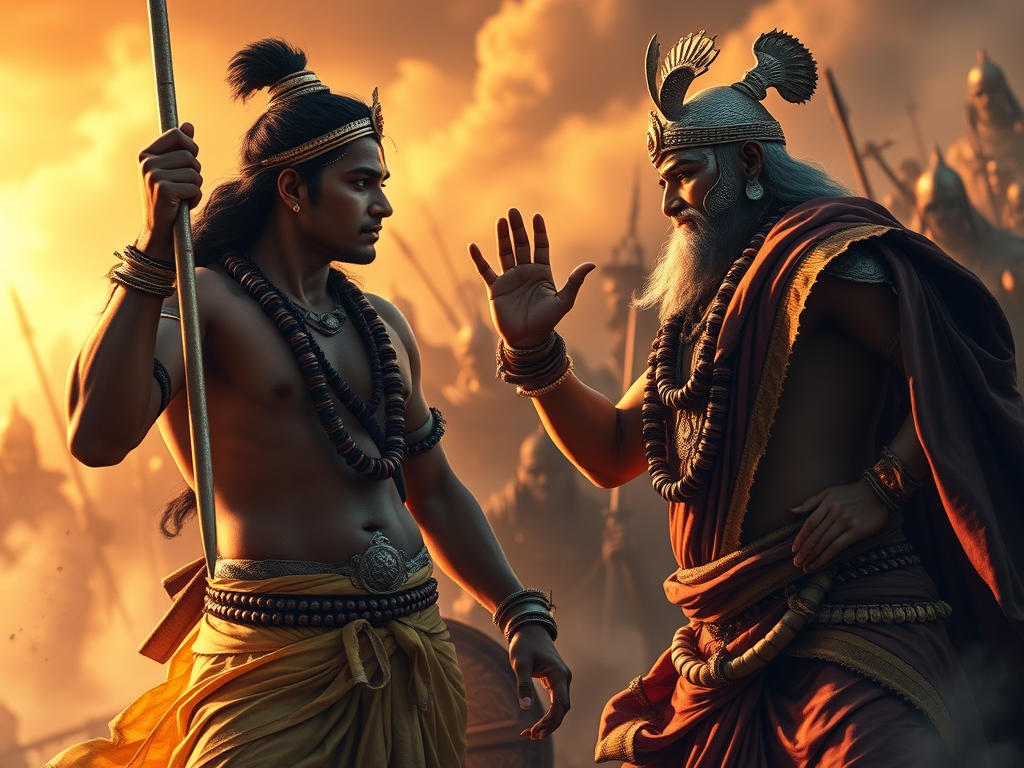
— The Bhagavad Gita Dismantles Passive Spirituality
A Plum Blossom Divination analysis of divine order vs human action
1. What Is the Bhagavad Gita?
The Bhagavad Gita is one of the most influential spiritual-philosophical texts in history.
It appears within the Indian epic Mahabharata as a dialogue between the warrior Arjuna and the divine Krishna on the battlefield of Kurukshetra.
The Gita integrates three spiritual paths:
- Karma Yoga (right action and responsibility)
- Jnana Yoga (wisdom and discernment)
- Bhakti Yoga (devotion and surrender)
Many modern readers interpret the Gita as teaching complete surrender to divine will — often summarized as:
“Everything happens according to God’s will.”
But when read carefully, the Gita presents a very different structure.
Because Krishna does not tell Arjuna to sit back and accept fate.
He tells him:
Stand up. Act. Fight. Fulfill your duty.
This alone challenges the idea of passive spirituality.
2. The Popular Interpretation — and Why It Feels Convenient
In modern spiritual culture, “God’s will” is often used like this:
- failure → God’s will
- suffering → God’s lesson
- inaction → surrender
- avoidance → trust in the universe
At first, this sounds peaceful.
But many people quietly realize something:
It makes life much easier when nothing is your responsibility.
And in practice, it often produces:
- hesitation instead of courage
- excuses instead of growth
- acceptance instead of change
- spiritual language instead of real effort
If this were truly the Gita’s message, the Gita would be a manual for giving up on life.
But it isn’t.
3. Why This Becomes a Misunderstanding
The confusion comes from mixing two different levels:
- Divine order (Dharma)
- Human action within that order
The Gita never teaches:
“God will do everything for you.”
Instead, it teaches:
God provides the structure — humans must act within it.
Divine will is not a remote control.
It is the operating system of reality.
You still have to press the keys.
4. Structural Inquiry (Plum Blossom Divination)
Question:
Does “everything is God’s will” in the Gita mean surrendering responsibility?
Or does it indicate a different relationship between divine order and human action?
Date: January 3, 2026
Location: Tokyo, Japan
Result: Heaven over Fire — Fellowship (Tong Ren), Second Line
5. What the Structure Reveals
“Fellowship” represents:
- cooperation
- shared purpose
- joint action
- unity through participation
This is not a symbol of passivity.
It is a symbol of collaboration.
The second line carries a warning:
- staying too enclosed
- failing to engage outwardly
- limiting action to inner belief
Applied spiritually, it points directly at passive surrender culture.
The message becomes clear:
Divine will is not meant to replace human effort.
It is meant to work together with it.
God does not live life for you.
God provides the framework in which you live it.
6. The True Meaning of “God’s Will” in the Gita
So what does “God’s will” actually mean?
Not:
- predetermined fate
- fixed destiny
- automatic outcomes
But:
the lawful structure of reality (Dharma).
It is direction, not execution.
The Gita’s formula can be summarized simply:
Leave the results to the divine.
But take full responsibility for your actions.
This is the heart of Karma Yoga.
7. Modern Misuse — When Surrender Becomes Avoidance
Here’s where people go wrong:
They replace:
- courage → with surrender language
- action → with trust language
- responsibility → with “letting go”
This creates a spirituality that feels peaceful but produces stagnation.
The divination structure clearly opposes this distortion.
Surrender is not retreat.
Surrender is disciplined engagement without attachment to outcome.
8. Practical Application for Modern Life
The Gita-aligned mindset looks like this:
❌ “I’ll wait and see what God does.”
◎ “I’ll act fully and let go of the result.”
❌ “It wasn’t my fault — it was God’s will.”
◎ “I take responsibility — the outcome belongs to reality.”
❌ “I surrender, so I won’t try.”
✅ “I surrender, so I try without fear.”
This transforms spirituality from passivity into power.
Conclusion (The line that spreads)
“Everything is God’s will” is not a license to escape responsibility.
It is an invitation to cooperate with reality itself.God sets the order.
Humans perform the action.
That is the Bhagavad Gita’s true teaching.
コメントを残す