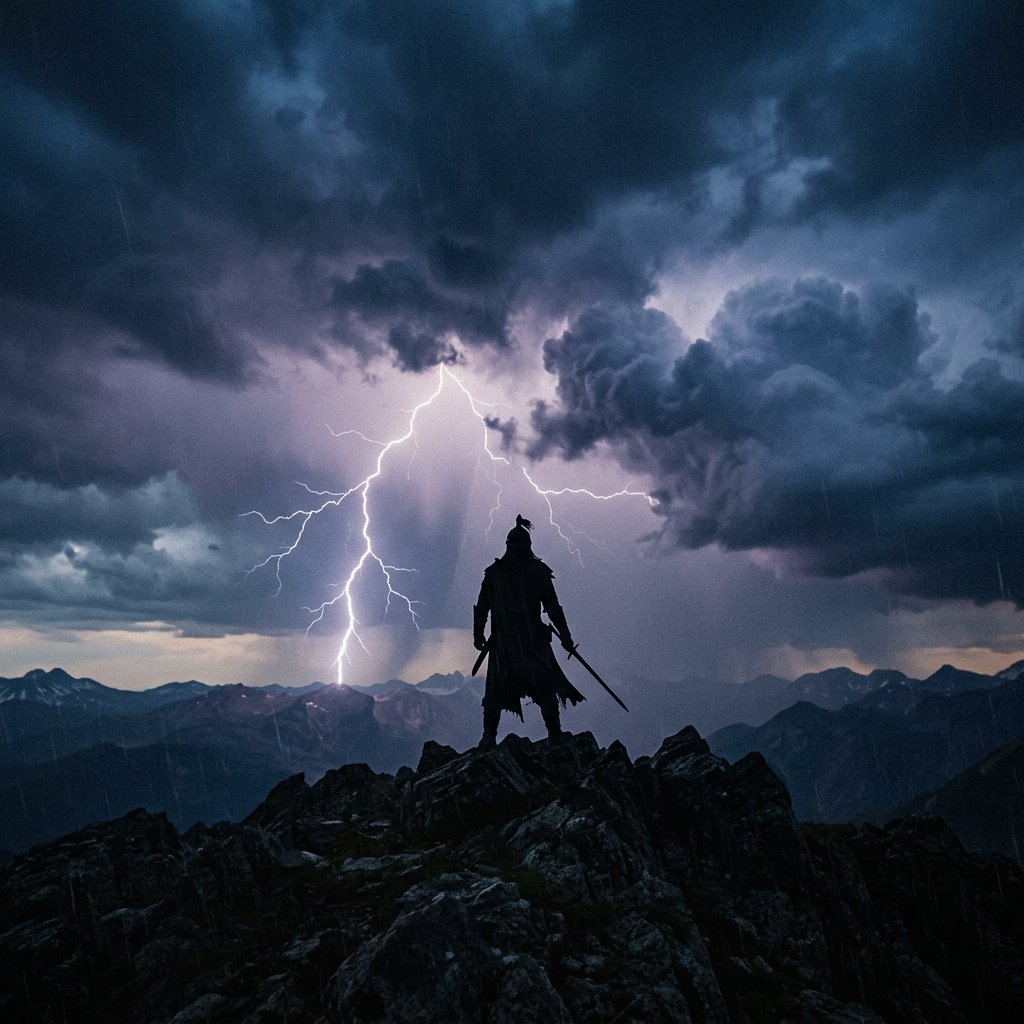
— A Meihua Yishu Reading of China’s “Monster Warriors” —
One of the eternal debates in Chinese history is this:
“If the greatest warriors in Chinese history fought one-on-one, who would be the strongest?”
The usual names always appear:
- 項羽
- 呂布
- 関羽
- 張飛
But once we dive deeper into Chinese history and legend, even more terrifying figures emerge:
- 李存孝
- 冉閔
- 趙雲
- 典韋
- 許褚
- 薛仁貴
Many of them were essentially described as “human weapons.”
So what happens if we examine this question through Meihua Yishu (梅花心易)?
This time, I cast the hexagram using the following date and time.
Divination Date
May 21, 2026 — 19:36
Calculation Method
Year branch: Horse = 7
Month = 5
Day = 21
Hour (Xu/Dog hour) = 11
Upper trigram:
(7+5+21)÷8=33÷8=4 remainder 1
Remainder 1 → Qian (Heaven)
Lower trigram:
(7+5+21+11)÷8=44÷8=5 remainder 4
Remainder 4 → Zhen (Thunder)
Moving line:
44÷6=7 remainder 2
Second line moving.
Resulting Hexagrams
Primary Hexagram
Heaven over Thunder — Wu Wang (无妄)
Transformed Hexagram
Heaven over Fire — Tong Ren (同人)
What “Wu Wang” Revealed
The moment I saw this hexagram, I found it fascinating.
Because this is the hexagram of the:
“Instinctive warrior beyond logic.”
Wu Wang represents action without artificial calculation.
It symbolizes:
- primal combat instinct
- explosive reaction speed
- overwhelming killing pressure
- raw survival ability
- “striking before thinking”
This is not the hexagram of a strategist.
Nor the hexagram of a tactician.
It is the hexagram of:
“A man who becomes the battlefield itself.”
And the lower trigram is Thunder.
Explosion.
Charge.
Instant domination.
In other words, this hexagram describes:
“A monster whose mere appearance changes the atmosphere of war.”
The Warrior Who Matched This Hexagram Most
The strongest resonance came from:
項羽
And honestly, this makes remarkable sense.
Xiang Yu was not merely “strong.”
In ancient China, he embodied the concept of:
“The enemy of ten thousand men.”
Stories describe him as:
- lifting massive bronze cauldrons
- breaking encirclements
- collapsing armies through sheer intimidation
- dominating battlefields through overwhelming force
This is almost a perfect manifestation of Heaven-Thunder Wu Wang.
And the transformed hexagram, Tong Ren, adds another layer:
It symbolizes not just strength, but:
- legendary status
- heroic mythification
- becoming an eternal symbol
Which explains why Xiang Yu is still remembered today as “The Hegemon-King.”
What About Lü Bu?
呂布
also matched extremely strongly.
Especially:
- Wu Wang’s savage instinct
- Thunder’s explosive violence
However, there is an important difference.
Xiang Yu becomes mythologized as a hero.
Lü Bu becomes mythologized as terror.
One inspires awe.
The other inspires fear.
That difference appears symbolically inside the “Tong Ren” aspect of the reading.
Li Cunxiao — The Inhuman Warrior
Another fascinating result was:
李存孝
In China, there is an old saying:
“Among kings, none surpass Xiang Yu.
Among generals, none surpass Li Cunxiao.”
This reading strongly resonated with him as well.
But unlike Xiang Yu, Li Cunxiao carried even more:
- Thunder-energy
- berserker aggression
- inhuman brutality
At that point, he feels less like a warrior…
and more like a natural disaster designed for combat.
Why Guan Yu and Yue Fei Felt Different
An interesting detail was that:
関羽
岳飛
did not fully align with this hexagram.
Why?
Because they symbolize something beyond raw violence:
- righteousness
- dignity
- discipline
- spirituality
- sacred authority
They are not “wild thunder.”
They feel closer to:
- Heaven
- Fire
- Mountain
types of symbolism instead.
And that distinction was extremely interesting.
Final Conclusion
According to this Meihua Yishu reading, the strongest “one-on-one combat” presences were:
- 項羽
- 李存孝
- 呂布
- 冉閔
Especially the hexagram Heaven-Thunder Wu Wang suggests:
“A being who dominates the battlefield before thought itself arises.”
Not strategy.
Not philosophy.
Not morality.
Pure martial force.
And Chinese history truly did produce such monsters.
コメントを残す