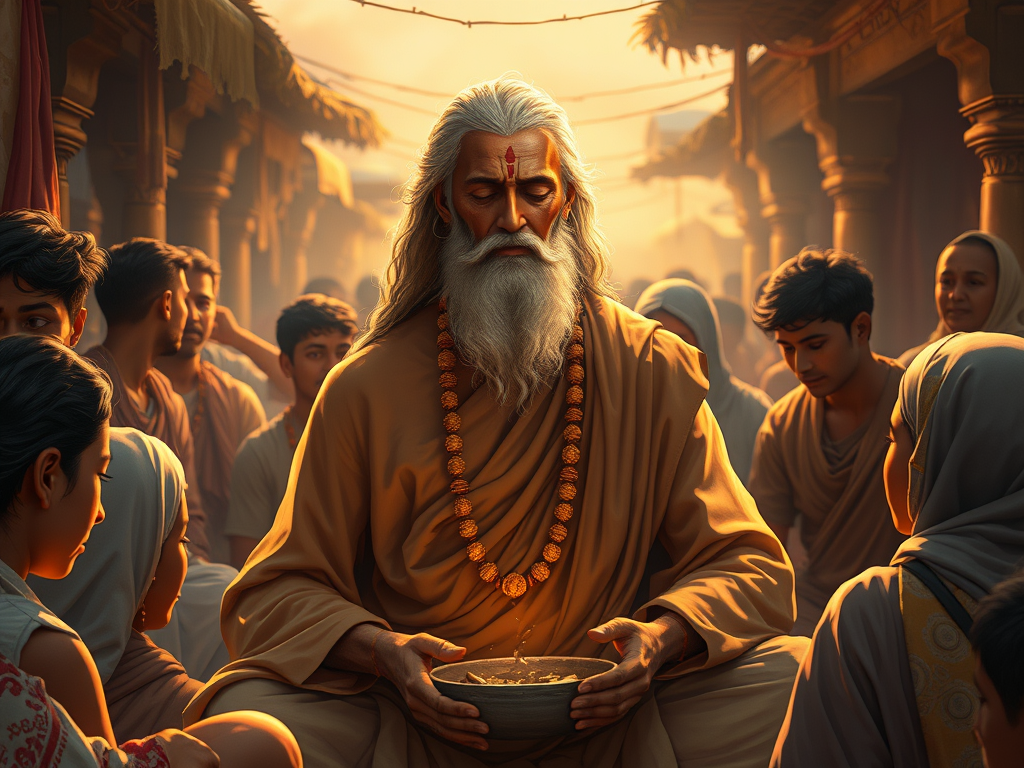
— Why the Bhagavad Gita Rejects the Myth of “Spiritual Retirement”
A Plum Blossom Divination Analysis of Action After Liberation
The Core Question
- Does liberation mean withdrawal from action?
- Do enlightened beings stop working?
- Is “just being” the final spiritual ideal?
In modern spirituality, one assumption circulates almost unquestioned:
“When you awaken, you no longer need to act.”
But when we read the Bhagavad Gita directly,
that assumption collapses.
1. The Popular Image of the Enlightened Person
The common image looks like this:
- desireless
- emotionally unmoved
- socially disengaged
- withdrawn from responsibility
- no longer producing or striving
In short:
To stop acting is to be free.
It appears serene.
It appears elevated.
But this image contains a fundamental flaw.
2. Why “Non-Action Enlightenment” Is So Attractive
The appeal is understandable.
- Action is exhausting.
- Responsibility is heavy.
- Judgment and failure are uncomfortable.
So the idea that enlightenment equals retirement from effort feels comforting.
“Once I awaken, I won’t have to carry this anymore.”
But comfort is not doctrine.
And the Gita is not written to soothe avoidance.
3. The Gita Explicitly Rejects Non-Action as Liberation
Krishna states clearly:
- No one can truly remain without action.
- Mere withdrawal from activity does not bring freedom.
- Avoiding duty does not produce liberation.
In fact, Arjuna is instructed not to withdraw —
but to act, and to act correctly.
This alone dismantles the “retirement” model of liberation.
The problem, according to the Gita,
is not action itself.
It is attachment within action.
4. Structural Inquiry (Plum Blossom Divination)
Question:
In the Bhagavad Gita, does a liberated being enter a state of non-action?
Date: January 3, 2026
Location: Tokyo, Japan
Result: Heaven over Fire — Fellowship (Tong Ren), Fifth Line
5. What the Structure Reveals
“Fellowship” represents:
- engagement with others
- participation in society
- shared purpose
- public responsibility
This is not the symbolism of isolation.
It is the symbolism of integrated presence.
The fifth line represents:
rightful position
influence without ego
leadership without self-centeredness
Applied to liberation, the implication is clear:
The liberated do not withdraw.
They participate without self-interest.
6. What Changes After Liberation?
Action does not disappear.
Its motivation changes.
The liberated being:
- acts without craving results
- performs duty without ego
- influences without attachment
- leaves no karmic residue
In other words:
Action continues.
Ownership dissolves.
7. Why the “Do Nothing” Myth Persists
The myth survives because it flatters avoidance.
It allows:
- disengagement to masquerade as transcendence
- passivity to masquerade as peace
- immaturity to masquerade as awakening
But the Gita never praises inactivity.
It praises purified action.
8. Practical Implications Today
A Gita-aligned understanding of liberation means:
❌ “If I were enlightened, I wouldn’t need to work.”
◎ “If I were enlightened, I would work without ego.”
❌ “Enlightenment frees me from responsibility.”
◎ “Enlightenment frees me from attachment to outcome.”
❌ “Doing nothing proves transcendence.”
◎ “Acting without self-centered motive proves maturity.”
Conclusion
Liberation does not end action.
It ends ego within action.The Bhagavad Gita does not celebrate the inactive sage.
It honors the one who acts without self-claim.
コメントを残す