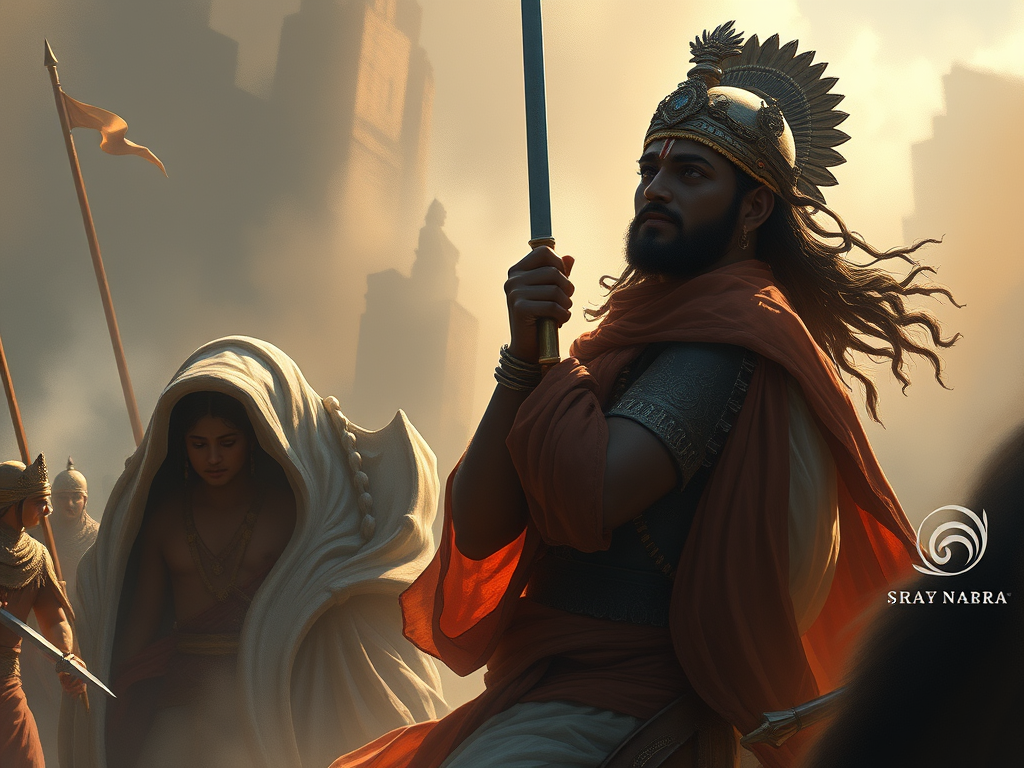
The Tension Between Spiritual Courage and the Survival Instinct
Introduction: What Is the Bhagavad Gita?
The Bhagavad Gita is a philosophical dialogue within the ancient Indian epic Mahabharata.
Its setting is not peaceful meditation — but a battlefield.
Prince Arjuna collapses in moral anguish. He trembles at the thought of killing teachers, relatives, and friends.
Krishna — his charioteer and divine guide — responds with teachings on:
- The eternal nature of the Self
- The inevitability of death
- Duty beyond personal fear
- Detachment from the transient body
Among its most controversial implications is this:
Do not fear death.
To some, this is liberating.
To others, it sounds dangerously close to glorifying death.
Is this a dismissal of human life?
Does it contradict our biological survival instinct?
Could it justify violence in the wrong hands?
Let us consult Plum Blossom Divination.
Casting the Question in Meihua Yishu
The inquiry posed:
“Is the teaching ‘Do not fear death’ spiritually dangerous?”
The hexagrams obtained were:
Primary Hexagram: Kan — Water over Water (The Abyss)
Changing Line: Third Line
Resulting Hexagram: Ji Ji — Water over Fire (After Completion)
This sequence speaks directly to the psychology of fear.
I. Kan — The Abyss of Fear
Kan represents water, depth, danger, and the abyss.
It symbolizes:
- Fear
- Risk
- The unknown
- Survival threat
Fear of death is not pathology.
It is biology.
The survival instinct is encoded into the nervous system.
To feel fear in the presence of mortality is not weakness.
It is intelligence.
Kan reminds us: danger is real.
II. The Third Line — Falling Too Deep
The third line of Kan warns:
“One sinks into the abyss.”
There are two possible distortions here:
- Being overwhelmed by fear.
- Denying fear altogether.
Both are dangerous.
If fear dominates, life shrinks into paralysis.
If fear is suppressed or dismissed, recklessness emerges.
The line warns against imbalance.
III. Ji Ji — Proper Arrangement
The resulting hexagram, Ji Ji (After Completion), represents balance.
Water and fire are placed in their proper positions.
Tension exists — but it is harmonized.
This is the key insight.
The teaching “Do not fear death” does not mean:
Eliminate fear.
It means:
Place fear in correct proportion.
Fear must not govern the whole system.
But it must not be erased.
IV. What the Gita Actually Means
When Krishna teaches that the Self is eternal, he is not trivializing life.
He distinguishes between:
- The mortal body
- The immortal consciousness
The instruction is metaphysical, not militaristic.
“Do not fear death” is not:
“Seek death.”
“Disregard life.”
“Become reckless.”
It is:
“Do not let mortality dictate your moral clarity.”
The teaching addresses existential fear — not practical caution.
V. The Ethical Risk
History shows that phrases like “Do not fear death” can be weaponized.
Used by:
- Political ideologies
- Military propaganda
- Fanatical movements
When detached from inner discipline, such teachings become tools of manipulation.
Kan warns us: depth without wisdom leads to drowning.
Context matters.
Audience matters.
Authority matters.
VI. Is There a Contradiction with Survival Instinct?
The survival instinct operates at the biological level.
Spiritual teaching operates at the ontological level.
They address different layers of existence.
Your body must avoid danger.
Your consciousness must not be ruled by terror.
There is no contradiction — only hierarchy.
Kan becomes Ji Ji when fear is integrated.
VII. The Hard Question
Is “Do not fear death” empowering — or irresponsible?
The answer depends on interpretation.
- As inner discipline: empowering.
- As external command: potentially dangerous.
The teaching is safe only when:
It strengthens personal responsibility.
It becomes dangerous when:
It removes personal judgment.
Final Conclusion
Plum Blossom Divination offers a balanced resolution:
Fear of death is natural.
Total surrender to fear is limiting.
Total denial of fear is reckless.
The teaching does not call for contempt toward life.
It calls for freedom from psychological domination by mortality.
“Do not fear death” does not mean:
Life is worthless.
It means:
Life must not be lived in chains.
Kan becomes Ji Ji
when fear is acknowledged,
but no longer sovereign.
Closing Reflection
Do you fear death?
Or do you fear losing control?
Spiritual maturity is not fearlessness.
It is proportion.
Not numbness.
Not fanaticism.
But clarity in the presence of the abyss.
コメントを残す