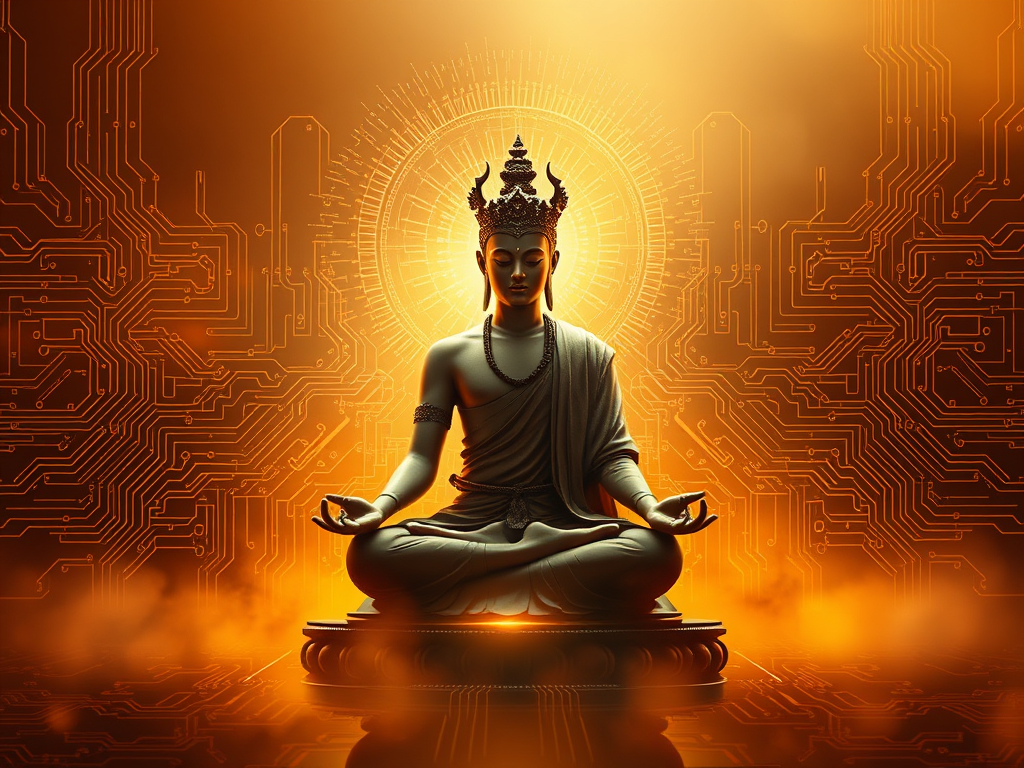
Is the Human Role Disappearing?
Introduction: What Is Dharma?
In the Bhagavad Gita, one of the central concepts is Dharma.
Dharma is often translated as “duty,” but this is only a partial understanding.
It also means:
- the underlying order of the universe
- one’s role within that order
- the essential function of one’s existence
For Arjuna, Dharma meant fulfilling his role as a warrior.
But today, this concept faces a serious challenge.
The Question
If AI replaces human work, does Dharma still exist?
If Dharma is tied to function,
and function is replaced by machines,
then what remains of human purpose?
Consulting Plum Blossom Divination
To explore this question symbolically, we turn to Meihua Yishu (Plum Blossom Divination).
The result:
Primary Hexagram: Wind over Heaven — Xiao Chu (The Taming Power of the Small)
Changing Line: Fifth Line
Resulting Hexagram: Heaven over Wind — Gou (Encounter)
This sequence offers a subtle but powerful insight.
I. Xiao Chu — Contained Potential
Xiao Chu represents restrained power.
Capacity exists,
but it is not fully expressed.
Energy is held back.
This mirrors the current human condition.
AI amplifies capability,
yet reduces the necessity for human action.
We are entering a state where:
We can do many things —
but we are no longer required to.
II. The Fifth Line — Maintaining the Center
The fifth line emphasizes trust and inner alignment.
The key message:
Stability comes from maintaining one’s center.
Here, Dharma shifts meaning.
It is no longer about external roles or occupations.
It becomes about inner orientation.
Dharma is not what you do.
It is how you are aligned.
III. Gou — The Encounter
The resulting hexagram, Gou, means “encounter.”
A sudden meeting with something powerful and unfamiliar.
AI represents exactly this:
A new form of intelligence entering human reality.
But Gou also carries a warning:
Do not be overwhelmed by what you encounter.
Engagement requires awareness.
Without awareness, one is absorbed.
IV. Does Dharma Disappear?
The answer is no.
But it transforms.
Stage 1: Role-Based Dharma (Pre-modern world)
Farmer
Warrior
Merchant
Dharma was tied to social function.
Stage 2: Choice-Based Dharma (Modern world)
Career
Self-actualization
Personal success
Dharma became a matter of individual choice.
Stage 3: Being-Based Dharma (AI era)
If AI performs most functions,
then what remains?
Consciousness.
Awareness.
Interpretation.
Meaning.
Dharma shifts from doing → being.
V. The Provocative Insight
AI does not destroy Dharma.
It exposes false Dharma.
The belief that:
“My job defines my value”
begins to collapse.
When function disappears,
identity must be reexamined.
VI. The Deeper View from the Gita
The Gita never defines Dharma as mere occupation.
It defines it as alignment with one’s nature and with the structure of reality.
Action is secondary.
Alignment is primary.
In an AI-dominated world, this becomes clearer.
Final Conclusion
Plum Blossom Divination suggests:
Xiao Chu — human capacity is restrained.
Fifth line — the center must be preserved.
Gou — a powerful encounter is underway.
The AI era is not the end of Dharma.
It is the end of superficial definitions of Dharma.
What remains is deeper:
A Dharma rooted not in function,
but in consciousness.
Closing Reflection
If your role disappears,
who are you?
If your function is replaced,
what remains?
AI does not answer this question.
It forces you to confront it.
And perhaps, for the first time,
Dharma becomes visible
not as something you perform —
but as something you are.
コメントを残す