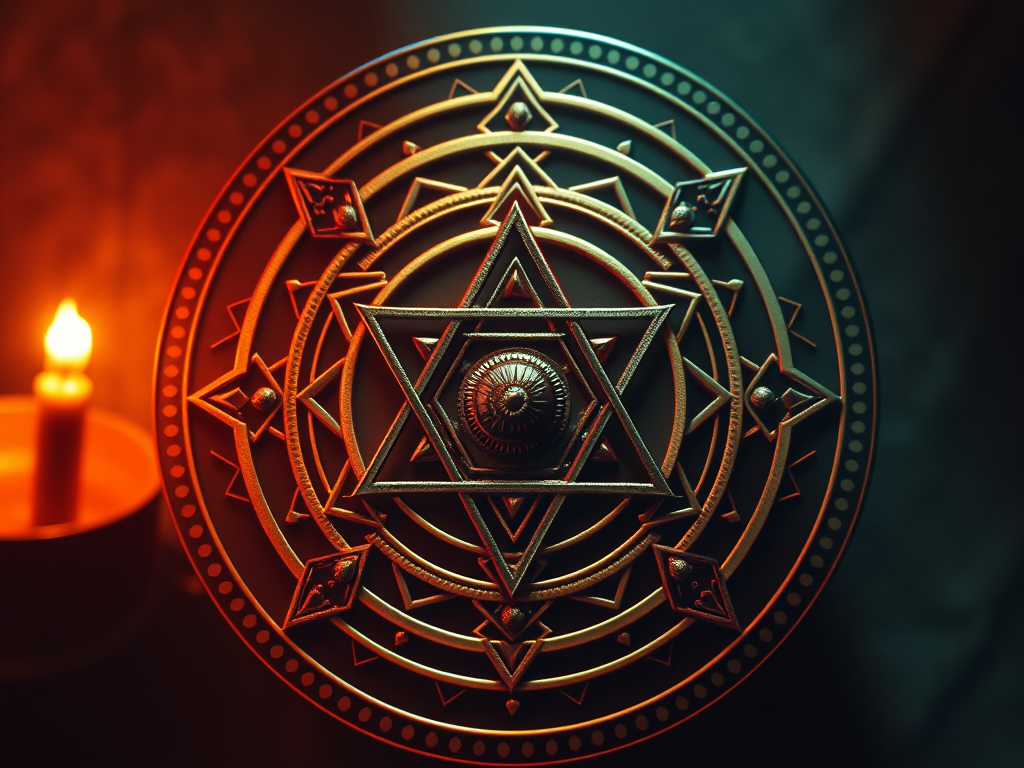
Chapter 1 — What Is a Yantra? The Truth Behind “Mantra in Form”
The common definition
Yantra (Sanskrit: “instrument,” “device”) is often described as a mantra in geometric form: a visual mechanism meant to render cosmic principles intelligible through shape.
- Triangle — fire, śakti, ascending current
- Circle — eternity, protection, cycles
- Square — earth, stability, boundary
- Bindu (central point) — the axis, the seat of the divine
The most famous example, the Śrī Yantra, is frequently presented as a diagram that “contains all forces of the universe.” Popular books and websites tend to exalt yantras as automatic “energy attractors,” bordering on a universal spiritual gadget.
The historical reality
Historically, many yantras are late proliferations. While texts do attest to ancient forms like the Śrī Yantra, a large number of “Deity-X Yantras” that appeared from the early modern period onward are little more than template reuse—the same geometry relabeled for different deities to serve sectarian prestige or commercial demand.
In short:
- Śrī Yantra → a core, classical symbol
- Many others → retrofits and mass-produced ritual/retail designs
Discerning what is genuinely traditional from what is a modern add-on is essential.
A Plum Blossom Divination look at “What is a yantra?”
Casting the question yielded Wind–Fire Family (家人) → Fire–Thunder Bite Through (噬嗑).
- Family/Household: structuring, ordering, giving a “frame” to life
- Bite Through: chewing through facades to reach the substance
Read: a yantra is both a framework that orders the house and, in many cases, decoration that must be chewed through to find truth. Not every yantra is mystical by default—discernment is part of the practice.
Bottom line
Yantras are symbolic forms of mantra—but not every yantra is a mystical machine. Only a subset function as profound structures (e.g., Śrī Yantra). Many “Deity-X” yantras serve primarily as icons that support devotion. The operative power depends less on the print and more on activation, method, and sincere practice.
Chapter 2 — Japa & Yantra: What Really Happens When Sound Meets Form
The standard claim
Tradition and modern spiritual guides often state:
- Mantra (sound) = vibrational manifestation
- Yantra (form) = geometric fixation of that vibration
- Together they produce synergy, so chanting in front of a yantra “doubles” the effect.
This is widely asserted, rarely tested.
Divinatory comparison: “Japa alone” vs “Japa before a yantra”
- Japa alone → Earth–Mountain Modesty (謙)
- Humble, steady, cumulative. The effect is real, but depends on time and repetition.
- Japa before a yantra → Fire–Heaven Great Possession (大有)
- Light gathers; power amplifies when sound and form resonate.
Takeaway:
- Japa works on its own (Modesty).
- A properly activated yantra can boost it (Great Possession).
- Fake/ornamental yantras yield placebo-level results.
Practical differences
Japa only
- Relies on your focus and stamina
- Slower, but foundational—“the ascetic’s highway”
Japa with yantra
- Aids concentration; can amplify if the yantra is alive
- Printed trinkets = mostly placebo
- Wrong pairing (mismatched deity/mantra) risks counter-effects
Conclusion:
- Think of a true yantra as a booster.
- Japa alone is fully sufficient—and over-reliance on props can hinder inner growth.
- Copies and stickers provide minimal benefit.
- Misuse can backfire.
Chapter 3 — Prāṇa-Pratiṣṭhā: Real Activation or Feel-Good Theater?
The claim
Prāṇa-pratiṣṭhā is the rite by which priests “install life-force (prāṇa)” into a yantra or image through mantras, fire offerings, and liturgy. Many temples/shops advertise:
- “Consecrated by X priests for Y days.”
- “Divine presence from the moment of activation.”
What’s not established is how long it actually lasts or how much transfers to the buyer.
Divination on efficacy
Question: Is prāṇa-pratiṣṭhā truly effective or just comforting?
Result: Thunder–Earth Joy (豫) → Mountain–Earth Stripping (剝)
- Joy/Rite/Celebration: powerful in the moment
- Stripping/Peeling: the aura falls away over time
Read: The rite works on site, then decays. The effect is non-zero, but short-lived unless the owner sustains it through practice.
Duration in real terms
- Immediate (0–2 weeks): palpable shift
- Short term (1–3 months): fading strength
- Mid term (6–12 months): mostly gone without daily japa
- Long term (>1 year): empty shell unless re-fired
Hence the market push for re-consecrations: not merely salesmanship—also the nature of energetic dissipation.
Bottom line:
Prāṇa-pratiṣṭhā is a spark, not a lifetime guarantee. The owner’s daily practice is what keeps the flame.
Chapter 4 — How Long Does Activation Last?
Divination: Fire–Water Not Yet Across (未濟) → Fire–Wind Cauldron (鼎)
- Not Yet Across: one-off activation is incomplete
- Cauldron: you must keep stoking the fire
Rule of thumb: Effectiveness tends to peak early, then drops within months unless there is regular re-fueling through the owner’s japa/offering routine.
Chapter 5 — Can an “Unactivated” Yantra Awaken Through Your Japa?
The sales narrative
“You must have a guru perform activation; DIY never works.” Convenient for repeat purchases; not always true.
Divination
Question: Can daily japa awaken an unactivated yantra?
Result: Water–Wind Well (井) → Wind–Thunder Increase (益)
- Well: dig consistently, and water will rise
- Increase: sustained effort brings growth
Practice math (guideline):
- ~10,000 recitations (~108/day for ~100 days): first felt shift
- ~30,000 recitations (6–12 months): stable resonance with the owner
- ~100,000 recitations (multi-year): robust self-sustaining activation
Conclusion:
You can awaken a yantra through your own practice. A priest’s rite is a spark; your japa is the well you dig. The latter binds the yantra to you.
Chapter 6 — Beyond the Śrī Yantra: Deity-Branded Yantras Under a Critical Lens
The pitch
“Every deity has a proprietary yantra (Gaṇeśa, Hanumān, Lakṣmī, etc.); place it and receive direct grace.”
In reality, many such designs recycle the same geometry (circles, triangles, hexagrams, lotus petals) with different labels.
Historical notes
- Śrī Yantra: traceable in classical tantra/post-Vedic sources; coherent cosmology
- Many ‘Deity-X’ yantras: medieval/modern derivatives, heavily popularized in the 19th–20th centuries
Divination
Question: Do these other deity yantras intrinsically carry divine energy?
Result: Mountain–Water Youthful Folly (蒙) → Thunder–Heaven Great Vigor (大壯)
Read: Most are didactic aids (Folly) that can feel potent temporarily (Vigor) if faith is high—but lack universal structural grounding.
Practical upshot:
- Śrī Yantra: high structural integrity; strong meditative support
- Others: may “work” as training wheels via belief; not universally reliable
- Cheap prints: virtually none
Chapter 7 — The “Shortlist” (Divination-Based Selection)
Question: Among the many yantras, which truly have spiritual efficacy?
Result: Heaven–Fire Fellowship (同人) → Heaven–Mountain Retreat (遯)
- Fellowship: a small, aligned cohort remains
- Retreat: the majority falls away
What likely remains
- Śrī Yantra (exceptional)
- Select prosperity yantras (e.g., Kubera) — effective when aligned with the owner’s intent
What’s conditional
- Many deity-name yantras (Gaṇeśa, Lakṣmī, Hanumān): faith-dependent
What to skip
- Navagraha mashups and mass prints: scattered force, little integration
Chapter 8 — Five Criteria for Choosing a Yantra That Actually Works
- Classical grounding
Does a primary text or coherent lineage support it? (Śrī Yantra: yes.) - Geometric integrity
Is the form structurally elegant and internally consistent? (Composite mashups: usually not.) - Sustainable activation
Can your daily practice re-ignite it over months/years? - Resonance with your devotion
Does the symbol genuinely connect with your heart? - Low risk of misuse
Universal diagrams (e.g., Śrī Yantra) carry lower mismatch risk than narrow deity-specific designs.
Practical recommendation:
- First choice: Śrī Yantra (classical, universal, low misuse risk)
- Conditionally useful: Kubera (prosperity), Gaṇeśa (obstacle-clearing)
- Auxiliary: Lakṣmī, Hanumān (faith-heavy)
- Avoid: Navagraha grids, generic prints
Core verdict: Not “everything works.” Only a few survive rigorous criteria.
Final Chapter — Deconstructing and Reframing the Yantra Myth
The myth
“Yantras are permanent divine devices; activation lasts forever; just buy and display.”
The reality
- Śrī Yantra is truly special.
- Many “deity yantras” are retrofits that function mainly as devotional icons.
- Prāṇa-pratiṣṭhā is an ignition, not a lifetime warranty.
- Navagraha collages disperse force; prints are décor at best (and can miscue attention).
The value that remains
Yantras do have value—when chosen and used well.
- Śrī Yantra = a robust cosmogram.
- Some wealth/removal yantras = effective when intention aligns.
- “Unactivated” yantras can be brought to life through 10k–100k sincere recitations.
The real power isn’t injected from outside; it’s awakened by your ongoing practice.
A Straight Question to the Reader
Which tier does your yantra belong to?
- S-Tier: Śrī Yantra
- Conditional: Kubera/Gaṇeśa (runs on sincere intent)
- Training wheels: Lakṣmī/Hanumān
- Mostly décor: Navagraha mashups and mass prints
The moment you begin to discriminate, your relationship with the yantra changes.
Japa × Yantra Effect Map (Divination-Informed)

- 🟩 Strong (Green): Correct yantra, genuinely activated → sound & form resonate, effects amplify (focus, protection, steadiness).
- 🟢 Moderate (Light Green): Unactivated yantra + sincere japa → acts as a visual concentrator; partial support.
- 🟨 Placebo-leaning: Cheap prints/stickers placed perfunctorily → mostly psychological.
- 🔴 Counter-effect: Mismatched deity/mantra or sloppy use → signal clash (restlessness, mental noise, temporary malaise).
- ⚪ Minimal: No devotion/attention; the yantra is mere décor.
Blunt summary:
A true yantra is a booster; a print is a picture.
Right yantra × right mantra × living practice is what matters.
コメントを残す