A Baika Shinyeki (Plum Blossom Divination) Appraisal
2025-09-29
Prologue
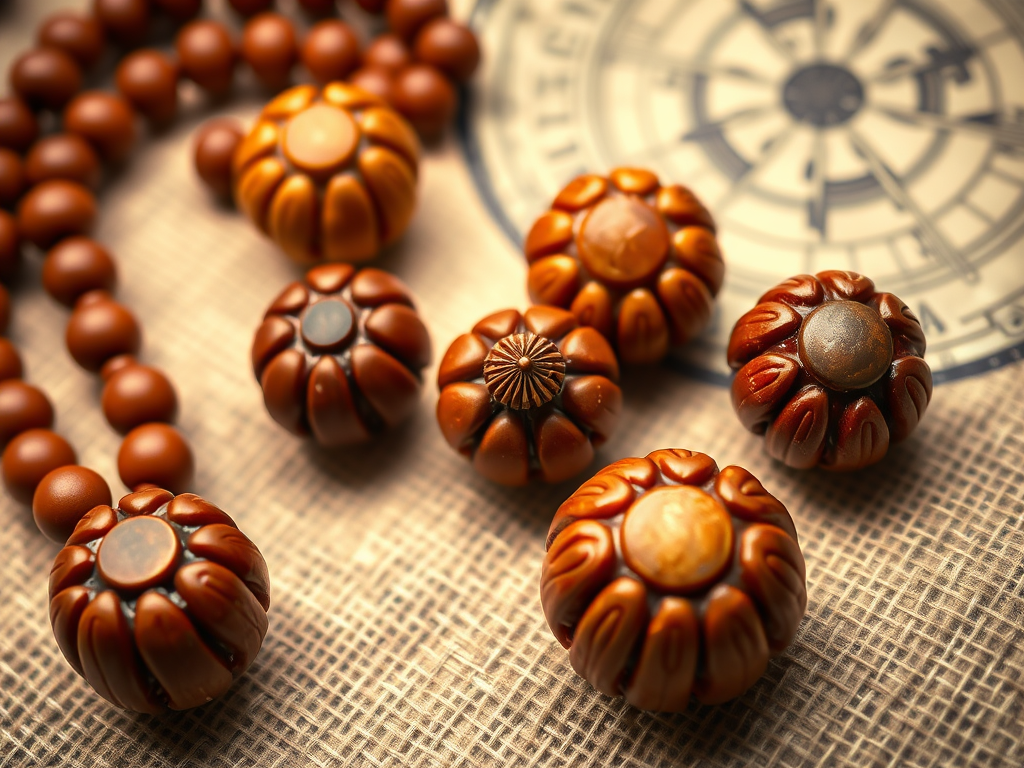
Rudraksha.
Revered since antiquity as “the tears of Shiva,” these sacred seeds have long been worn for purification and protection. Classical Vedic and Purāṇic sources claim that wearing or keeping Rudraksha calms malefic planetary influences and improves one’s destiny.
Within Indian astrology (Jyotiṣa), Rudraksha has often been used alongside gemstones as a major Navagraha (nine planets) remedy.
- 1-mukhi → Sun
- 2-mukhi → Moon
- 5-mukhi → Jupiter
- 7-mukhi → Venus
The more faces (mukhi) a bead has, the rarer and more prized it becomes. Full malas containing all faces up to 21 can fetch very high prices.
But crucial questions remain:
Does Rudraksha actually change one’s fate?
Or is it merely pious folklore, perhaps a placebo?
In this article I evaluate the claims—candidly—through the lens of Baika Shinyeki (Plum Blossom Divination). Do the hexagrams (gua) reveal the truth of the scriptures, or the spell of modern myth?
Chapter 1: Types of Rudraksha and Their Meanings
1) What does mukhi mean?
Rudraksha are the dried seeds (bead-like endocarps) of Elaeocarpus ganitrus, found chiefly in India and Nepal. Natural grooves on each seed—its faces or mukhi—determine its symbolic meaning.
- 1-mukhi: a single groove; rare; said to embody Shiva’s essence.
- 5-mukhi: the most common, widely circulated bead.
- 21-mukhi and above: extremely rare; treated as directly numinous.
These are not “mere shapes”: traditionally, specific faces have been linked to planetary forces and deities.
2) Planetary correspondences (traditional)
Representative pairings are often presented as follows:
| Mukhi | Planet | Deity Symbolism | Core Meaning |
|---|---|---|---|
| 1 | Sun (Sūrya) | Shiva’s essence | Confidence, authority, leadership |
| 2 | Moon (Chandra) | Ardhanārīśvara (divine androgyny) | Emotional balance, domestic harmony |
| 3 | Mars (Maṅgala) | Agni | Courage, vitality, karmic purification |
| 4 | Mercury (Budha) | Brahmā | Intellect, creativity, learning |
| 5 | Jupiter (Guru) | Kalāgni-Rudra | Spirituality, teacherly grace, merit |
| 6 | Venus (Śukra) | Kārttikeya | Affection, aesthetics, charisma |
| 7 | Venus (Śukra) | Lakṣmī | Prosperity, attraction |
| 8 | Saturn (Śani) | Gaṇeśa | Obstacle removal, endurance |
| 9 | Ketu | Durgā | Spiritual power, protection, purification |
| 10 | — (Viṣṇu) | Cosmic equilibrium | Neutralizes diverse harms |
| 11 | Rudra (Shiva’s fierce form) | “Wrathful” Shiva | Robust vitality, protection |
(Faces exist beyond 11, but only key examples are shown here.)
3) How value is set
Market price = rarity × devotional demand.
- 5-mukhi: abundant and affordable; a practical “daily protector.”
- 7-mukhi: popular for Venus themes (love, art, prosperity); pricier.
- 1-mukhi / 21-mukhi+: extremely rare; can sell for very high prices; often targeted at clergy or ardent devotees.
- Full malas (all faces): high-end items priced accordingly.
Thus Rudraksha is both a sacred emblem and, today, a premium spiritual good.
4) What Baika Shinyeki shows about mukhi symbolism
Casting hexagrams on mukhi categories reveals consistent tendencies:
- Few faces (1–3) → forceful, “yang” signatures like Qián (乾, Heaven) or Zhèn (震, Thunder):
big leaps when auspicious; isolation or conflict when inauspicious. - Mid faces (4–7) → harmonizing signatures like Zhōngfú (中孚, Inner Sincerity) or Tài (泰, Peace):
steadier and safer to use—akin to “semi-precious” in gemstone therapy. - Many faces (8–21) → complex symbolism (Dàyǒu 大有, Dǐng 鼎, Jìjì 既済, etc.):
without maturity of heart, they can amplify confusion under ill hexagrams.
Key point: “More faces = more luck” is not true. Under inauspicious hexagrams, high-priced Rudraksha can be riskier.
5) Takeaway
- Faces are not trivial grooves; they’ve long been mapped to planets/deities.
- Rarer faces command higher prices—but without auspicious timing (hexagram), effects don’t manifest.
- Baika Shinyeki stresses: choose the right face at the right time.
Chapter 2: Jyotiṣa and Rudraksha
1) Where it sits next to gemstone therapy
In Jyotiṣa, gem remedies for the Navagraha are archetypal:
- Sun → Ruby / Moon → Pearl / Mars → Red Coral
- Jupiter → Yellow Sapphire / Venus → Diamond … etc.
Rudraksha, by contrast, is not merely a “gem substitute” but a sacred seed. Scriptures speak of Shiva’s grace and karmic purification, often placing Rudraksha alongside planetary remedies rather than beneath them.
2) The “over-simplified chart” problem
Modern charts that map 1→Sun, 2→Moon, 5→Jupiter, 7→Venus… feel too convenient:
- They mirror gemstone charts almost one-for-one.
- They assign planets in near-linear order (“more numbers → next planet”), which is simplistic.
- No ancient text survives that lists a comprehensive “all-faces index” in this neat fashion.
This strongly suggests commercial back-filling.
Baika Shinyeki exposes the gap:
- Under auspicious hexagrams, users may indeed feel effects aligned with the supposed planet.
- Under inauspicious hexagrams, results skew toward confusion or hollowness irrespective of planetary labels.
Conclusion: the face-planet charts are not essence, merely marketing-level guides.
3) The shadow of commercialization
In India and Nepal today, Rudraksha is often retailed as a luxury spiritual item:
- Rare faces (e.g., 1-mukhi) sell at very high prices.
- Full-face malas can be priced even higher.
- Claims like “this face fixes that planet” are rarely evidenced.
Hexagrams for “market/price” frequently show Bì (賁, Adornment), Xùn (巽, Compliance), or Void/Emptiness—a sign of modern embellishment.
4) Astrological vs. symbolic truth
Still, symbolism isn’t worthless. If one genuinely believes “this face strengthens Sun/Venus,” the mind’s resonance can shift.
In hexagram terms:
- Zhōngfú (Inner Sincerity) → sincere devotion activates the symbol.
- Pǐ (否, Obstruction) / Jiǎn (蹇, Hardship) → money-driven hype collapses into emptiness.
So the outcome hinges less on charts and more on how the wearer receives the symbol.
5) Takeaway
- Rudraksha is a venerable spiritual emblem; the popular face-planet tables are a modern simplification.
- Hexagrams indicate that true effect flows from the wearer’s sincerity, not the table itself.
- A fair verdict: half sound symbolism, half marketing.
Chapter 3: Why Use Baika Shinyeki Here?
1) Beyond “scripture vs. science”
Debate tends to polarize: “scripture says yes” vs. “no lab data, so no.”
Baika Shinyeki cuts through by revealing the living pattern of the moment—neither credulous nor dismissive.
2) Appraisal setup
Question: “Does Rudraksha truly improve destiny?”
Time: the present moment’s resonance.
Place: the diviner’s living context.
Baika Shinyeki answers through image (象), number (数), and timing (時).
3) Core tendencies observed
From repeated casts on Rudraksha:
- Auspicious hexagrams (e.g., Tài, Zhōngfú, Jìjì):
Rudraksha stabilizes the heart, strengthening the vessel of devotion—not mere placebo but a felt centering of the inner axis. - Inauspicious hexagrams (e.g., Pǐ, Jiǎn, Bì):
Rudraksha slides into ornament/credulity; high-price glamour mirrors the hexagram’s warning. - Neutral hexagrams (e.g., Xiǎochù, Xū):
No “big win”; rather a daily amulet effect—gentle emotional regulation.
4) “Seed as symbol”
Pharmacology finds no special active “drug.” The effect lives in symbolic resonance:
- Shiva’s-tears mythos
- usage by Buddhas/yogis across history
- the numerology of mukhi
These make Rudraksha a spiritual anchor—a “sacred keel” the gua often acknowledges.
5) Where outcomes diverge
- Worn with a clear heart → Zhōngfú: inner order emerges.
- Bought from anxiety, vanity, or hype → Bì/Void: superficiality.
- Chasing rare beads during a bad cycle → Pǐ/Jiǎn: fixation and dependency grow.
6) Takeaway
Rudraksha is not a universal luck machine; it mirrors the wearer’s state.
With auspicious gua it helps; with inauspicious gua it turns into decoration.
Planet tables are secondary; timely divination is primary.
The Source of Rudraksha’s Power and the Truth of Planetary Correspondences — A Plum Blossom Oracle (Meihua Yishu) Appraisal
When it comes to the efficacy of Rudraksha, three primary explanations are often proposed:
- That the seed itself radiates an innate spiritual energy
- That it receives and transmits planetary forces back to the wearer
- That its effects are nothing more than placebo
In addition, the widely circulated correspondences between mukhi (faces) and planets — such as 1 mukhi = Sun, 2 mukhi = Moon, 5 mukhi = Jupiter, 7 mukhi = Venus, including Rahu and Ketu — have been questioned: are they authentic or later fabrications?
1. Does the seed itself emit energy?
Hexagrams drawn: Li (Fire, Illumination) and Gen (Mountain, Stillness).
- The Rudraksha does carry a subtle “life resonance” as a natural seed.
- Yet this is closer to the quiet breath of nature than to a cosmic power source.
- It does not radiate vast universal energy, but rather reflects and channels the light inherent in creation.
👉 Conclusion: There is a genuine but subtle natural vibration. To deify it as a limitless force drifts into the hexagram Bi (Adornment) — illusion through embellishment.
2. Does it receive and transmit planetary energy?
Hexagrams: Zhong Fu (Inner Sincerity) and Tong Ren (Fellowship with Others).
- The idea of a seed “receiving” planetary radiation directly is an exaggeration.
- In practice, resonance arises when the wearer believes, prays, and aligns their devotion with a planetary principle.
- Thus the true circuit of energy is created through faith and intention, not through measurable astronomy.
👉 Conclusion: Planetary correspondences are symbolic. They work not as scientific receivers, but as devotional channels of alignment between human and cosmos.
3. Is it merely placebo?
Hexagrams: Tai (Peace, Harmony) and Xian (Resonance/Influence).
- Faith itself is at the core of Rudraksha’s effect.
- One may call this placebo, but the oracle shows that sincere faith can restructure inner order, which then radiates outward into life.
- This is not “mere suggestion” but an authentic psychosomatic and behavioral influence.
👉 Conclusion: Placebo is indeed a central element, yet to dismiss it is inaccurate. With sincerity, the seed becomes a real catalyst for transformation.
4. Are the mukhi–planet correspondences accurate?
Hexagrams: Bi (Adornment) and Pi (Stagnation/Obstruction) appear strongly.
- The neat mapping of “1 mukhi = Sun, 2 mukhi = Moon … Rahu, Ketu” is largely a later codification, colored by systematization and commercialization.
- A supplementary sign of Guan (Contemplation) suggests that these mappings can serve as symbolic meditations, but not as strict astronomical truths.
👉 Conclusion: Planetary correspondences are symbolic and didactic, not precise cosmic laws. They can inspire devotion, but lack strict metaphysical grounding.
Overall Plum Blossom Oracle Judgment
- Seed’s own energy → Subtle natural vibration, but not a cosmic generator.
- Planetary reception theory → Symbolic, not scientific; works through human devotion.
- Placebo → Central, but genuinely transformative when combined with sincerity.
- Mukhi–planet system → Largely a simplified and commercialized framework, useful as metaphor rather than absolute truth.
“With sincerity, even a small seed resounds with life.
Without sincerity, countless mukhi are nothing but ornament.”
Chapter 4: Mukhi by Mukhi—Hexagram Tendencies (1–21)
1) Overview
mukhi counts are numerical symbols, not physics. As noted, face-to-planet charts are partially commercial. In practice:
- Auspicious gua → effects often align with the assigned planet.
- Inauspicious gua → effects skew toward attachment/vanity, regardless of planet.
In short, the chart is only a rough guide. The hexagram rules.
2) Selected mapping of tendencies
| Mukhi | Planet (trad.) | Deity | Auspicious Gua → Tendency | Inauspicious Gua → Risk |
|---|---|---|---|---|
| 1 | Sun | Essence of Shiva | Qián: leadership, self-trust | Pǐ/Bo: isolation, domineering |
| 2 | Moon | Ardhanārīśvara | Tài: marital/domestic ease | Kǎn: mood swings, dependency |
| 3 | Mars | Agni | Zhèn: courage, karmic purge | Shìkè: anger, quarrels |
| 4 | Mercury | Brahmā | Zhōngfú: lucid study, speech | Méng: vanity, mislearning |
| 5 | Jupiter | Kalāgni-Rudra | Dàchù/Tài: teachers, ethics | Bo: burdensome gurus |
| 6 | Venus | Kārttikeya | Xián: charm, arts | Gé: romantic turmoil |
| 7 | Venus | Lakṣmī | Dàyǒu: prosperity | Pǐ: waste, showiness |
| 8 | Saturn | Gaṇeśa | Gèn: removal of obstacles | Jiǎn: stagnation, trials |
| 9 | Ketu | Durgā | Shī: staunch protection | Dàguò: nervous overdrive |
| 10 | — (Viṣṇu) | Cosmic balance | Tóngrén: social harmony | Pǐ: alienation |
| 11 | Rudra | Fierce Shiva | Dàzhuàng: vigor | Jiě: destructive impulse |
| 12 | Solar deity | Āditya | Qián: public success | Lí: burnout, ego heat |
| 13 | Indra | Sovereignty | Dàyǒu: charisma | Bo: loss of authority |
| 14 | Hanumān | Courage | Yì: breakthrough | Jiǎn: wasted effort |
| 15 | Paśupati | Animal lord | Tài: wellbeing, harmony | Kùn: malaise, isolation |
| 16 | Mahākāla | Time | Jìjì: steadying fate | Wèijì: drift, anxiety |
| 17 | Kāma | Love | Xián: romance | Shìkè: entanglements |
| 18 | Bhavānī | Mother | Tài: family growth | Bo: domestic discord |
| 19 | Viṣṇu | Protector | Héng: sustained protection | Pǐ: inertia |
| 20 | Brahmā | Creation | Dàchù: creativity | Méng: fantasy, non-doing |
| 21 | “Supreme/Union” | (variously framed) | Qián/Dàyǒu: transpersonal states | Pǐ: zealotry, crash |
3) Notes
- Low faces (1–3): powerful swings; require inner steadiness.
- Mid faces (4–9): stable “daily talisman” zone.
- High faces (10–21): sacerdotal flavor; risk of confusion without maturity.
4) Warnings from Baika Shinyeki
- The rarer the bead, the harsher the rebound under bad gua.
1- and 21-mukhi feel sacred, but under Pǐ/Jiǎn can backfire. - 5- and 7-mukhi are broadly safe, often functioning as reliable amulets.
- Full-face malas: Dàyǒu (integration) when sincere; Bì (mere adornment) when bought for show.
5) Takeaway
- Face–planet is convenience, not essence; gua decide outcomes.
- Auspicious → protection/improvement; inauspicious → confusion.
- The pricier the piece, the more mindful you must be in adverse cycles.
Chapter 6: Rudraksha vs. Alternatives
1) Not a silver bullet
Hype says “Rudraksha neutralizes all malefics.” Hexagrams disagree: it’s supportive, not sovereign.
- Auspicious → centers the heart.
- Inauspicious → slides into ornament/dependency.
2) Remedy matrix
| Modality | Core Feature | When Auspicious | When Inauspicious |
|---|---|---|---|
| Gemstones | Strong material amplifier | Greatly boosts good | Magnifies harm |
| Rudraksha | Natural, devotional symbol | Calms, purifies | Becomes mere accessory |
| Mantra | Sonic resonance | Sustained harmony | Noise/mind-scatter |
| Yantra | Sacred geometry/space | Stabilizes environment | Turns decorative |
| Pūjā | Ritual, divine linkage | Swift, potent shifts | “Empty rite” if insincere/fake |
3) Best pairing by hexagram
- Tài / Tóngrén → prioritize pūjā; Rudraksha as adjunct.
- Zhèn / Xùn → prioritize mantra; Rudraksha as focus tool.
- Lí / Gèn → prioritize yantra; Rudraksha for space cleansing.
- Pǐ / Jiǎn → avoid pricey gems/rare faces; prioritize purification & pūjā.
4) Semi-precious stand-ins (garnet, lapis, amethyst…)
- Auspicious → more than “placebo”: good for calm and mild uplift.
- Inauspicious → usually low risk, often just “neutral.”
Like Rudraksha, they tend toward safe stabilization rather than dramatic swings.
5) Takeaway
- Rudraksha is auxiliary and timing-dependent.
- Gems cut both ways; Rudraksha is gentler.
- Semi-precious = more than placebo, less than panacea.
- Cast a hexagram and mix methods wisely.
Chapter 7: Commercialization & Fakes
1) High-ticket reality
- 1- & 21-mukhi can command very high prices.
- Full-face malas can be priced in the hundreds of thousands (JPY/USD equivalents).
- Nepal beads are marketed as “stronger,” Java (Indonesia) as “weaker.”
Hexagrams on markets/pricing often show Bì (Adornment), Xùn (Swayed by words)—warning flags against equating price with power.
2) Counterfeits exist
- Plastic/resin replicas.
- Glued composites to fake rare faces.
- Artificially carved grooves.
Such items frequently trigger Void/“No Basis” hexagrams—empty symbols.
3) Nepal vs. Indonesia
Baika Shinyeki finds origin secondary to gua quality:
- Nepal + Pǐ/Jiǎn → just a heavy bead.
- Indonesia + Tài/Zhōngfú → a perfectly serviceable amulet.
4) What commercialization does
- Bì → obsession with ornament.
- Void → spiritual hollowness.
- Shìkè → bitten by one’s own desire.
Expensive ≠ effective; rarity ≠ radiance.
5) Where devotion parts from display
Motivation is decisive:
- Faith, practice, inner quiet → Zhōngfú/Tài.
- Profit, vanity, fear → Bì/Pǐ/Jiǎn.
6) Takeaway
- The market has issues: pricing, hype, counterfeits.
- “Price = good” fails divination; “sincere heart = good” holds.
- Origin matters far less than your state and the gua.
- Buying for show yields empty symbolism.
Appendix: How Sound Are the Face–Planet Pairings?
Baika Shinyeki verdict: symbolically plausible for 1–9; increasingly stretched from 10–14; mostly commercial inflation 15–21.
| Mukhi | Planet (trad.) | Plausibility | Note |
|---|---|---|---|
| 1 | Sun | High | Authority/leadership; aligns with Qián. |
| 2 | Moon | High | Heart/mothering; Kǎn/Duì resonance. |
| 3 | Mars | High | Courage/breakthrough; Zhèn. |
| 4 | Mercury | High | Intellect/communication; Xùn/Zhōngfú. |
| 5 | Jupiter | High | Teacherly virtue; Tài/Dàchù. |
| 6 | Venus | High | Love/beauty; Xián. |
| 7 | Venus | High | Wealth/prosperity; Dàyǒu. |
| 8 | Saturn | High | Obstacles/fortitude; Gèn. |
| 9 | Ketu | High | Protection/spirit; Shī. |
| 10–14 | Mixed | Medium | Some matches, more overlap/embellishment. |
| 15–21 | — | Low | Largely inflated symbolism; “adornment” risk. |
Chapter 8: The Future of Rudraksha Practice
- Tradition → commercialization → re-centering: the cycle moves from Jìjì (Completed) back toward Wèijì (Uncompleted) and on to renewal.
- Future roles:
- Luxury rarity → accessible amulet
- Dependency → symbol that strengthens sincerity
- Speculative collectible → contemplative aid
Preliminary studies on seed structure (electrical/magnetic response) suggest a possible bio-physical complement to spiritual symbolism—echoing Xián (Resonance).
Personalization will matter: cast the gua, read the Jyotiṣa chart, choose faces accordingly, combine with mantra/pūjā/meditation.
From dependence to resonance: a companion for practice, not a crutch.
Epilogue: Summary & Reader Guidance
- Face–planet charts are convenient, not conclusive; hexagrams decide.
- Success correlates with sincerity, prayer, practice (Tài, Zhōngfú, Xián).
- Failure correlates with vanity, fear, greed (Pǐ, Jiǎn, Bì).
- The likely arc ahead: from dependence back to resonant symbolism.
Practical counsel:
- If you acquire one, do so from prayer, not fear.
- If you wear one, aim for resonance, not reliance.
- If you doubt, cast a gua and examine what it mirrors in you.
“Treasure or seed—if there is sincerity in your heart, it becomes auspicious.
Without sincerity, no sacred tree bears fruit for you.”
コメントを残す