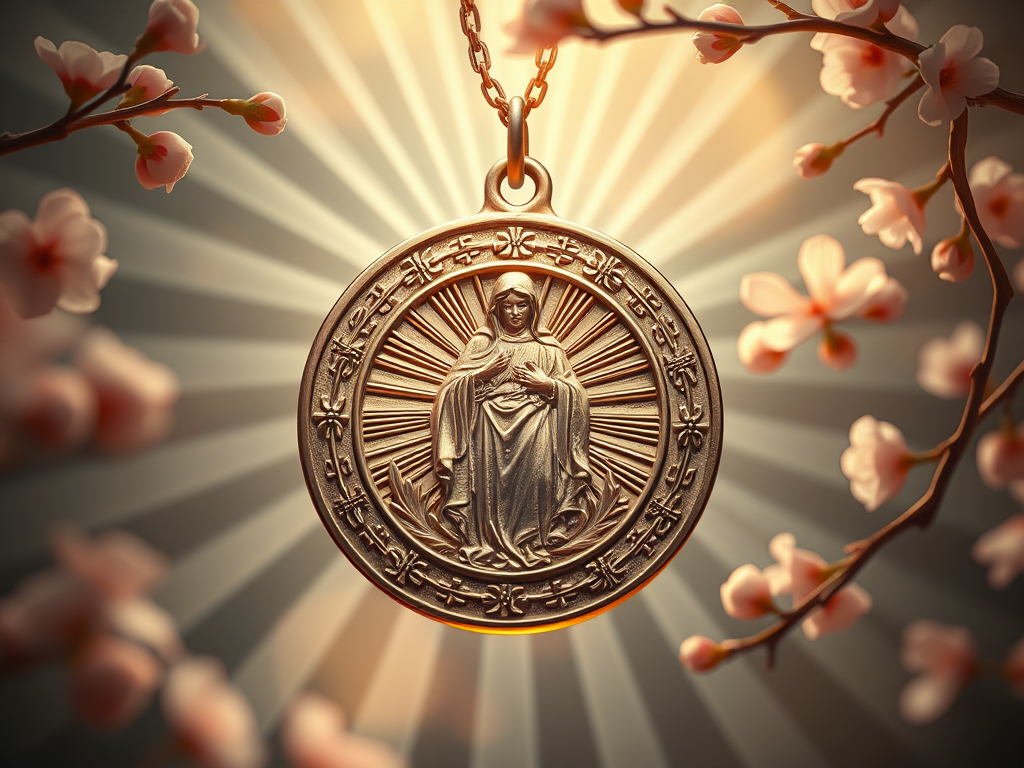
Subtitle: Does a symbol of faith truly operate as an auspicious force “here and now”?
Scope: Miraculous Medal (Paris, 1830 – global devotion) / Scapular traditions
Method: Plum Blossom Divination (象 image • 数 number • 時 timing) applied to mystique, efficacy, and ethical use
Safety Note: This essay is a cultural–spiritual study. It does not offer medical advice. Health, crisis management, and legal compliance must always follow proper professional guidance.
Prologue | Why Judge the Miraculous Medal through Plum Blossom Divination?
Since its first diffusion in 19th-century France, the Miraculous Medal has been cherished as a focus of prayer, conversion, and consolation. Countless testimonies—healings, reconciliations, sudden inner transformations—have attached themselves to the small oval medal depicting the Virgin Mary and her symbols.
Yet alongside this aura of devotion, shadows persist: commercialization, superstition, exaggerated promises, and theological disputes over idolatry.
Here lies the task: how do we discern truth from illusion, symbol from superstition, in a way that honors both faith and reason?
Plum Blossom Divination (Meihua Yishu, 梅花心易)—an ancient method of reading “image, number, and timing” from chance, circumstance, and resonance—offers a distinctive lens. Unlike dogmatic verdicts, it does not attempt to declare once-and-for-all metaphysical truth. Rather, it asks:
- What does this symbol mean in the present moment?
- For the one who holds it, is it auspicious (吉), inauspicious (凶), or neutral (中)?
- What hidden patterns of timing and intention shape its effect?
By applying the triad of image, number, and time, we can treat the Miraculous Medal not merely as a historical relic or object of debate, but as a living symbol that either supports or obstructs spiritual order depending on the heart of the bearer.
This essay, therefore, places the medal on the divinatory table—neither to venerate it uncritically, nor to dismiss it cynically, but to examine its mystique, its effects, and its place within universal spiritual law.
Chapter 1 | Origins and Diffusion: Untangling the Legend
1.1 The Parisian Beginning
The story begins in Paris, 1830. A young novice of the Daughters of Charity, Catherine Labouré, reported visions of the Virgin Mary within the chapel on Rue du Bac. In these apparitions, she described a luminous figure of Mary, rays of light streaming from her hands, and the words inscribed around her image:
“O Mary conceived without sin, pray for us who have recourse to thee.”
Mary, she said, commanded that a medal be struck in this likeness and distributed. The promise was simple yet profound: those who wore the medal with faith would receive great graces.
By 1832, amidst a devastating cholera epidemic, thousands of these medals were struck and distributed across Paris. Reports of protection, healing, and conversion spread rapidly. Soon the medal was being referred to by the people themselves as miraculous (médaille miraculeuse).
1.2 The Iconographic Language
The medal’s imagery quickly became a catechism in metal:
- Front side (Obverse):
- Rays streaming from the hands: symbols of grace poured forth.
- Inscription: “O Mary conceived without sin…”—a crystallization of Marian dogma before its formal declaration (Immaculate Conception, 1854).
- Reverse side:
- The letter M intertwined with a cross: Mary’s participation in the work of Christ.
- Two hearts: one pierced with a sword (Mary’s sorrowful heart), the other crowned with thorns (the Sacred Heart of Jesus).
- Twelve stars encircling: the universal Church, echoing Revelation 12.
Each symbol carried layers of scriptural and theological meaning, but in popular devotion, they became shorthand for trust, protection, and maternal intercession.
1.3 The Expansion of a Devotion
From Paris, the devotion spread rapidly across Europe and beyond:
- 1830s–1840s: medals distributed through missions, parishes, and popular confraternities.
- 1850s: bolstered by papal recognition, the medal became an official sacramental of the Catholic Church.
- 19th–20th century: linked with Marian apparitions (e.g., Lourdes, 1858), reinforcing its place in the landscape of Catholic piety.
It became not just an object, but a global cultural icon—adopted by the poor as a simple token of comfort, by the devout as a seal of consecration, and even by skeptics as a curiosity of “folk Catholicism.”
1.4 The Meaning of “Miraculous”
The term miraculous did not originate from ecclesiastical decree but from the people themselves. It was the spontaneous response to lived experiences: conversions of hardened skeptics, healings unexplained, reconciliations of estranged families.
In Plum Blossom terms, the medal’s spread coincided with hexagrams such as “观 (Contemplation)”—urging inner vision—and “中孚 (Inner Sincerity)”—emphasizing that when faith is sincere, symbols become vessels of grace.
Thus the “miracle” lay less in the object itself, and more in the inner shift it catalyzed. The medal became a mirror in which people saw their own capacity for change, courage, and devotion.
1.5 Early Critiques and Shadows
But where there is fervor, shadows follow:
- Superstition: Treating the medal as an automatic charm guaranteeing health, wealth, or safety.
- Commercialization: Mass-production and profit, often divorced from devotion.
- Doctrinal suspicion: Protestant reformers criticized it as idolatrous; rationalists dismissed it as mere placebo.
In divinatory reflection, such tendencies align with the hexagram “贲 (Adornment)”—symbolizing superficial glitter, empty ritual, and reliance on form over substance.
1.6 Chapter 1 Summary
The Miraculous Medal emerged at a time of social unrest and epidemic fear, when people yearned for tangible signs of hope. Its symbols, deeply rooted in Catholic theology, offered not only doctrinal meaning but psychological and communal reassurance.
Plum Blossom Divination confirms this ambivalence:
- 吉 (Auspicious): When worn as a focus of sincere prayer, aligned with “中孚” and “观,” the medal channels order and peace.
- 凶 (Inauspicious): When reduced to magical ornament, aligned with “贲” and “否,” it becomes empty metal, breeding disappointment or superstition.
Thus from the very start, the “miraculous” medal was both a vessel of grace and a mirror of projection—its power lying not in silver or bronze, but in the sincerity of the heart that wears it.
Chapter 2 | The Question of Mystique — Re-reading Tradition and Symbol
2.1 Layers of Interpretation
The Miraculous Medal exists simultaneously on several planes:
- Historical Layer — A 19th-century Catholic movement arising in the turbulence of post-revolutionary France, when epidemics and political unrest generated a deep hunger for signs of divine nearness.
- Symbolic Layer — A collective psychological response: in times of fear and uncertainty, tangible anchors for hope become essential.
- Superstitious Layer — Stories of “instant cures” or “automatic protection” quickly grew, sometimes eclipsing the deeper call to prayer and conversion.
2.2 The Symbolic Grammar
The medal’s images are not arbitrary; they are a theological shorthand.
- Rays of light: grace descending into human affairs.
- Inscription: an invocation affirming the immaculate purity of Mary.
- Intertwined hearts: sorrow and love bound in redemptive unity.
- Twelve stars: the cosmic and ecclesial community.
Read symbolically, the medal functions as a “language of heaven”—a translation of abstract theology into images accessible to ordinary believers.
2.3 The Risk of Exaggeration
Yet devotion easily drifts into magical thinking. “Wear this medal and you will never suffer.” “Buy this medal and your business will prosper.”
Plum Blossom Divination cautions that such tendencies align with the hexagram “贲 (Adornment)”: beauty without substance, outward form masking inward emptiness. When the symbol becomes a talisman of guaranteed success, it loses its true power.
2.4 Divinatory Judgment on Mystique
From the perspective of Meihua Yishu:
- Auspicious Hexagrams (吉):
- “观 (Contemplation)” — the symbol inspires inner vision, prompting reflection and transformation.
- “中孚 (Inner Sincerity)” — when faith is sincere, the medal becomes a vessel of grace.
- “泰 (Peace)” — order and harmony descend when the symbol leads to ethical action.
- Inauspicious Hexagrams (凶):
- “贲 (Adornment)” — devotion reduced to ornament or superstition.
- “否 (Obstruction)” — prayer blocked by dependence on the object alone.
- “蹇 (Difficulty)” — obsession with immediate results, leading to disappointment.
Summary of Chapter 2:
The mystique of the Miraculous Medal lies neither in denying miracles nor in promising automatic guarantees. Its power is symbolic: it shapes the heart and directs the gaze upward. When interpreted through Plum Blossom Divination, it functions as an instrument of order only when joined with sincerity, humility, and patience.
Chapter 3 | The Debate on Idolatry — Protestant Critique and Universal Judgment
3.1 The Critique of Idolatry
As the Miraculous Medal spread, so did criticism. Protestant theologians in particular asked: Is this not idolatry?
Their arguments rested on two pillars:
- Christ as the sole mediator — To place Mary, or any object, between the soul and God was seen as diminishing the sufficiency of Christ.
- Biblical prohibitions — “You shall not make for yourself a graven image” (Exodus 20). “God is spirit, and those who worship must worship in spirit and truth” (John 4:24).
From this perspective, directing prayer toward a metal object—even if Marian in imagery—risked obscuring direct communion with God.
3.2 Catholic Response
Catholic theology, however, has long insisted:
- The medal is not an idol. It does not contain divine power in itself.
- It is a sacramental: a symbolic focus that gathers the believer’s prayer, directing it toward God through Mary’s intercession.
- Its purpose is not to replace prayer, but to sharpen its sincerity and constancy.
The distinction lies in whether one treats the medal as God Himself (idolatry) or as a window pointing toward God (sacramental symbolism).
3.3 Plum Blossom Divination’s Perspective
How does Meihua Yishu read this tension? The hexagrams reveal three layers of truth:
- When “中孚 (Inner Sincerity)” appears:
The medal is a vessel, not a rival. If the heart is sincere and directed toward the divine, the symbol becomes an instrument of alignment, not an idol. - When “观 (Contemplation)” emerges:
The medal points beyond itself, lifting the gaze. Here, symbolism serves as a mirror of transcendence. - When “贲 (Adornment)” or “否 (Obstruction)” dominates:
The object is absolutized. “This medal will save me” becomes a closed door, faith reduced to fetish. In cosmic judgment, such reliance veers into error.
3.4 Cosmic Law: Are Idols Evil?
The divinatory pattern teaches a subtle truth:
- A symbol is empty by itself. It is neither holy nor evil.
- The heart determines its polarity: sincerity (中孚) turns it into a vessel of grace; vanity (贲) reduces it to superstition.
- Even Protestants, while rejecting external symbols, risk “idolatry of words”—when doctrine itself becomes a hardened image.
- Thus the true axis of cosmic judgment is not the presence of form but the presence of truthful sincerity.
3.5 Case Illustrations
- A bedridden believer holds the medal and prays sincerely to God → hexagram “中孚.” The medal serves as a focus, not an idol.
- A merchant sells medals as guaranteed prosperity charms → hexagram “贲.” The object is stripped of grace and reduced to merchandise.
- A strict critic rejects all symbols outright, scorning those who use them → hexagram “否.” A closed heart, equally unbalanced.
3.6 Chapter 3 Summary
Plum Blossom Divination renders a verdict beyond denominational lines:
- Idolatry is not the presence of form, but the absence of sincerity.
- The medal is not inherently sinful. It becomes a problem only when treated as a magical guarantee or substituted for living faith.
- In cosmic judgment, the decisive criterion is the heart’s sincerity (cheng, 誠).
“Consecration” and Daily Prayer — Are They Truly Required for the Medal’s Efficacy?
Around the Miraculous Medal, two common claims are often repeated:
- “Unless a priest consecrates or ‘opens’ the medal, it has no effect.”
- “Unless the prayer ‘O Mary, conceived without sin, pray for us who have recourse to thee’ is recited daily, the medal will not work.”
Through the lens of the Plum Blossom Oracle, the following judgments appear:
1. Is priestly consecration indispensable?
The oracle revealed Zhong Fu (Inner Sincerity) and Guan (Contemplation/Viewing).
- If sincerity is present, the absence of consecration does not invalidate the symbol’s effect.
- A priestly blessing may indeed serve as a communal act of contemplation, deepening focus, and thus is auspicious — but not essential.
- The shadow of Bi (Adornment) also appeared, warning that if ritual form is treated as absolute, it devolves into vanity and becomes inauspicious.
👉 Conclusion: Priestly consecration is a helpful supplement, but the belief that “without it the medal has no power” is a superstitious exaggeration.
2. Is the daily prayer formula mandatory?
The oracle showed Heng (Constancy) and Xian (Resonance/Influence).
- A daily prayer rhythm functions as constancy, anchoring the mind and heart, and can be beneficial.
- Yet Pi (Obstruction) was also present, indicating that mere repetition without sincerity turns the act into hollow dependence, stripping it of power.
👉 Conclusion: Reciting the prayer once a day can serve as a rhythm that aligns the heart, but the medal does not “switch off” if the formula is omitted. The true key lies in sincerity.
Overall Oracle Assessment
- Consecration → Not essential. Sincerity itself activates the symbol.
- Prayer routine → Helpful when heartfelt, harmful if reduced to empty obligation.
- Cosmic judgment → The focus is never on outer form but on the sincerity of the heart.
“The symbol is not the form itself but the mirror of sincerity.
With sincerity, form amplifies the light.
Without sincerity, form collapses into vanity.”
Chapter 4 | Reading the Miraculous Medal through Plum Blossom Divination
4.1 Image (象) — The Visual Symbolism
The Miraculous Medal is essentially a condensed iconography, and Plum Blossom Divination interprets it as a constellation of images:
- Material (metal) → “艮 (Stillness)” — solidity, endurance, the power to hold.
- Circular shape → “乾 (Heaven)” — totality, wholeness, the enclosing of all things.
- Radiant rays → “离 (Fire/Light)” — illumination, divine clarity, exposure of darkness.
- Twin hearts (Mary’s pierced, Jesus’ crowned) → “咸 (Resonance)” — the heart moved by compassion, evoking response in others.
- Twelve stars → “同人 (Community)” — the shared destiny of the faithful gathered around one center.
Thus the medal is not only a devotional object but a symbolic equation: Heaven + Light + Resonance + Community.
4.2 Number (数) — Timing and Cycles
Plum Blossom Divination always asks: When is this symbol efficacious?
- Auspicious hexagrams for adoption:
- 泰 (Peace): moments when heaven and earth are aligned, auspicious for new devotion.
- 中孚 (Sincerity): when the heart seeks honesty and reconciliation.
- 同人 (Fellowship): when entering into community or shared prayer.
- 恒 (Perseverance): when beginning a long-term spiritual practice.
- Inauspicious hexagrams for adoption:
- 否 (Obstruction): when life is blocked, devotion can slip into dependence.
- 蹇 (Difficulty): when motivation is rooted in fear or desperation.
- 贲 (Adornment): when the desire is merely to “look spiritual” or impress others.
- 坎 (Danger): when health, safety, or finances are manipulated by superstition.
Timing is not trivial: to adopt a symbol in the wrong season, with the wrong motive, risks draining rather than strengthening.
4.3 Moment (時) — Motivation and Context
The divination also probes why the medal is being used:
- If the motive is prayer, forgiveness, or reconciliation → auspicious.
- If the motive is fear, vanity, or commercial promise → inauspicious.
- If the motive is gratitude and commitment → stable.
- If the motive is anxiety alone → unstable.
Summary of Chapter 4:
The medal becomes effective when its image resonates with one’s heart, when the timing is harmonious, and when the motivation is sincere. Without all three, its symbolism collapses into emptiness.
Chapter 5 | Practical Templates — How to Divine and Apply
5.1 Defining the Question
In practice, the divination must be formulated clearly:
- “Is it auspicious for me to wear the Miraculous Medal now?”
- “Is the primary purpose protection, conversion, reconciliation, or comfort?”
- “Should this devotion be paired with pilgrimage, confession, or daily prayer?”
The clarity of the question shapes the clarity of the answer.
5.2 Three-Stage Judgment
Plum Blossom Divination suggests a three-step filter:
- Safety — If the hexagram shows 坎 (Danger) or 否 (Obstruction), refrain from action; do not expect protection from the medal in physical matters.
- Suitability — If 中孚 (Sincerity) or 泰 (Peace) appear, the motive is aligned with divine order.
- Action — If 恒 (Perseverance) or 同人 (Fellowship) arise, incorporate the medal into daily prayer or community ritual.
5.3 Suggested Output Format
A practical reading can be recorded as:
Hexagram: [Name] → [Transforming Hexagram]
Judgment: [Auspicious / Conditional / Inauspicious]
Purpose: [Protection / Reflection / Reconciliation / Devotion]
Action: [Daily prayer / Forgiveness act / Pilgrimage / Community prayer]
Care: [Clean medal / Replace cord / Dispose respectfully if damaged]
Re-divination: [After X weeks / At seasonal festival / After major life event]
5.4 Illustrative Example
- Question: “Should I wear the medal during my illness?”
- Hexagram drawn: “中孚 (Inner Sincerity)” transforming into “泰 (Peace).”
- Judgment: Auspicious, if worn as a reminder to pray with sincerity.
- Action: Daily prayer with gratitude, alongside medical treatment.
- Care: Do not rely on the medal as a cure; integrate with healthy discipline.
5.5 Emphasis on Non-Magical Use
Plum Blossom is clear: the medal is never a magic key. It is a focus for sincerity, a mirror of intention. The most dangerous mistake is to believe that the object itself compels the universe.
Summary of Chapter 5:
Practical divination enables believers to discern the when and why of devotion. By framing questions, filtering outcomes, and applying results with humility, the medal becomes what it was meant to be: a vessel of sincerity, not a talisman of control.
Chapter 6 | The Scapular and the Scapular Medal — Comparative Reading
6.1 Historical Origins
While the Miraculous Medal emerged in 19th-century France through the vision of Catherine Labouré, the Scapular devotion traces its roots back to the Middle Ages, particularly within the Carmelite Order. Originally, the scapular was a simple garment symbolizing service and consecration. Over time, a smaller version—the Scapular Medal—was authorized as a substitute for practical reasons of hygiene and durability.
Both traditions emphasize commitment and continuity, but they manifest differently: the medal highlights Mary’s intercession, while the scapular emphasizes daily fidelity and belonging.
6.2 Symbolic Grammar
| Aspect | Miraculous Medal | Scapular / Scapular Medal |
|---|---|---|
| Primary Symbol | Rays, Hearts, Stars, Mary’s intercession | Garment of consecration, sign of belonging |
| Purpose | Conversion, protection, contemplation | Daily promise, perseverance, spiritual identity |
| Plum Blossom Core | 离 (Light) × 中孚 (Sincerity) | 恒 (Perseverance) × 同人 (Community) |
Thus:
- Medal = the mirror of awareness (awakened in moments of conversion, prayer, or crisis).
- Scapular = the robe of continuity (a slow garment of discipline, daily fidelity, and perseverance).
6.3 Combined Use
When both devotions are practiced together:
- Medal → first awakens awareness (离 / Light).
- Scapular → sustains the practice in daily fidelity (恒 / Perseverance).
Plum Blossom suggests a sequence: Awakening (Medal) → Perseverance (Scapular).
Chapter 7 | Case Studies — Auspicious, Inauspicious, and Neutral
7.1 Auspicious Case: Conversion and Reconciliation
- Situation: A man estranged from his family receives the Miraculous Medal as a gift.
- Hexagram: 中孚 (Inner Sincerity) changing to 泰 (Peace).
- Result: With daily prayer and a single act of forgiveness (writing a letter of apology), the relationship begins to heal.
- Interpretation: The medal catalyzed a moment of sincerity, channeling it into concrete reconciliation.
7.2 Inauspicious Case: Exaggeration and Dependency
- Situation: A woman purchases multiple medals marketed as instant cures for illness and guaranteed prosperity. She does not engage in prayer or inner discipline.
- Hexagram: 贲 (Adornment) changing to 否 (Obstruction).
- Result: Economic strain, disillusionment, and disappointment. No inner change, no outward fruit.
- Interpretation: Faith collapsed into ornament. The medal became an idol of vanity, judged inauspicious.
7.3 Neutral Case: Waiting and Preparation
- Situation: A young seeker, overwhelmed by anxiety, impulsively considers adopting the devotion.
- Hexagram: 需 (Waiting).
- Result: The divination counsels postponement. Instead of immediate adoption, the seeker prepares through pilgrimage, prayer, and reflection. A month later, the hexagram changes to 泰 (Peace), signaling readiness.
- Interpretation: The medal is not a magic switch; it becomes effective only when “the time is ripe.”
7.4 Broader Lesson
The case studies reveal a consistent principle:
- 吉 (Auspicious): when sincerity transforms symbol into vessel.
- 凶 (Inauspicious): when vanity or fear reduces symbol to fetish.
- 中立 (Neutral): when the symbol is approached prematurely, awaiting the right alignment of time and heart.
Summary of Chapter 7:
The Miraculous Medal and the Scapular alike are not guaranteed forces but mirrors of the heart. Through Plum Blossom Divination, their efficacy is measured not by claims of miracle but by sincerity, timing, and alignment with life’s moral order.
Chapter 8 | Commercialization, Counterfeits, and Ethics
8.1 The Allure of Commercialization
As devotion to the Miraculous Medal spread globally, so did the temptation of commerce.
Vendors promoted the medal with slogans such as:
- “Wear this medal and you will never suffer harm.”
- “Purchase one for prosperity and protection in business.”
- “A limited edition medal blessed for instant miracles.”
Plum Blossom Divination consistently warns that such claims align with the hexagram 贲 (Adornment) — glittering outward form with hollow interior. What was meant to be a focus of prayer can quickly become a consumer fetish.
8.2 Counterfeits and Fraud
Alongside commercialization came falsification:
- Cheap alloys masquerading as silver or gold.
- Mass-produced imitations sold as “blessed by Rome.”
- Resin or plastic medals polished to appear metallic.
In divinatory terms, such practices resonate with 坎 (Danger) — hidden risk, betrayal, and harm. Faith is poisoned not only by false symbols but also by the dishonesty surrounding them.
8.3 Ethical Responsibility
Devotional commerce is not evil per se; artisans and ministries require support. The ethical line is crossed when:
- Transparency is abandoned (false claims of origin, blessing, or effect).
- Fear is exploited (“Without this medal, disaster will strike”).
- Excessive prices transform devotion into luxury trade.
Plum Blossom Guidance:
- 中孚 (Sincerity): Price and purpose should be transparent.
- 大畜 (Accumulation): Testimonies should be collected without exaggeration, forming a reservoir of honest experience.
- 坎 (Danger): Exploitation of fear is forbidden.
8.4 Ethical Commercial Model
A positive model would be:
- Affordable pricing, accessible to ordinary believers.
- Charitable allocation, with proceeds funding works of mercy.
- Honest testimony, emphasizing prayer and perseverance rather than instant miracle.
Summary of Chapter 8:
Commercialization without sincerity leads to exploitation and counterfeit. With integrity and transparency, however, the production and distribution of medals can be a legitimate ministry, harmonizing material means with spiritual purpose.
Chapter 9 | Conditions for True Efficacy — Keys from Plum Blossom Divination
9.1 The Core Principle
The Miraculous Medal is not a charm. Its efficacy emerges only under strict conditions revealed through Plum Blossom Divination:
- Sincere motive (中孚 / Inner Sincerity): Fear, vanity, or commercial calculation corrupt its use.
- Small daily acts (离 → 恒 / Light → Perseverance): A single prayer, a small act of forgiveness, or one disciplined gesture each day sustains its power.
- Community (同人 / Fellowship): Shared prayer multiplies resonance.
- Timeliness (泰 / Peace, 需 / Waiting): Do not force results. Wait for alignment of inner and outer conditions.
- Exit strategy (否 / Obstruction, 坎 / Danger): When dependence, superstition, or financial burden appear, stop.
9.2 Practical Keys
- Start with sincerity: Before adopting the medal, clarify your intention: is it prayer, reconciliation, gratitude, or fear?
- Integrate with daily rhythm: Do not expect fireworks; instead, let the symbol anchor your routine.
- Combine with action: Use the medal as reminder of concrete deeds: forgiveness, moderation, service.
- Share with discernment: Praying with even one companion strengthens efficacy.
- Know when to release: If devotion feels burdensome, coercive, or hollow, step back and re-evaluate.
9.3 White and Black Verdict
Plum Blossom Divination ultimately renders a dual outcome:
- White (Effective): When sincerity, continuity, and community converge, the medal genuinely assists in inner transformation and outer reconciliation.
- Black (Ineffective or Harmful): When exaggerated promises, dependency, or commercial exploitation dominate, the medal loses efficacy and can even hinder faith.
9.4 Cosmic Law Restated
The cosmic law is simple:
“A symbol becomes a vessel when filled with sincerity. It becomes empty when clothed only in vanity.”
Thus, the medal itself is neither salvation nor sin. Its efficacy is wholly contingent on the state of the heart and the integrity of practice.
Summary of Chapter 9:
The Miraculous Medal works not by material power but as a mirror of sincerity. Its true condition is the triad of sincere motive, disciplined continuity, and proper timing. Without these, it is nothing more than metal.
Chapter 10 | Practical Guide — How to Engage with the Medal
10.1 Receiving the Medal
- Purification: Clean gently with mild soap and cloth before first use.
- Intention-setting: Offer a short declaration of purpose (“May this medal focus my prayer toward forgiveness and peace”).
- Blessing: If possible, request blessing from a priest or spiritual guide.
10.2 Wearing the Medal
- Daily Wear: Safe to wear on the chest as reminder of prayer.
- During Sleep: Remove if uncomfortable or unsafe.
- Damage: If broken, dispose respectfully with gratitude, or bury rather than discard casually.
10.3 Daily Prayer Protocol
- Structure:
- Forgiveness (release of resentment).
- Gratitude (acknowledge blessings).
- Petition (requests for aid).
- Flexibility: Add personal phrases; sincerity matters more than formula.
- Duration: Even one minute, if consistent, builds resonance.
10.4 Giving the Medal
- Consent: Ensure recipient’s openness. Forced gifting carries the hexagram 否 (Obstruction).
- Context: Pair with prayer and explanation, not with superstition.
- Meaning: Present as invitation to reflection, not as “instant miracle charm.”
10.5 Record-Keeping
- Diary: Note date, emotional state, and any significant events.
- Review: After a month, reflect: did your prayers shape new actions, reconciliation, or calmness?
- Adjust: If use feels hollow or anxious, pause; the hexagram 需 (Waiting) teaches patience and reevaluation.
Final Chapter | Plum Blossom Divination’s Ultimate Verdict
11.1 The Nature of the Medal
The Miraculous Medal is not a magical machine. It is a vessel of focus:
- When filled with sincerity (中孚), it amplifies prayer and supports reconciliation.
- When used for vanity, fear, or commercial exploitation (贲, 否), it becomes empty metal.
11.2 White Verdict — Efficacious Conditions
- Sincerity: Pure motivation of prayer, forgiveness, or devotion.
- Continuity: Daily discipline, however small.
- Community: Shared prayer strengthens its resonance.
- Timing: Align practice with meaningful days or seasons.
11.3 Black Verdict — Inefficacious or Harmful Conditions
- Exaggeration: Believing the medal guarantees instant miracles.
- Dependency: Using it to avoid responsibility or medical treatment.
- Commercialization: Falling into predatory trade or fear marketing.
- Pride: Treating it as badge of superiority rather than tool of humility.
11.4 Beyond Catholic-Protestant Debate
Plum Blossom Divination reframes the dispute over idolatry:
- A symbol itself is neutral.
- With sincerity, it becomes a window to the Divine.
- Without sincerity, it collapses into ornament or even burden.
Thus, the cosmic law is universal: judgment lies not in the object but in the heart’s truth.
11.5 The Final Maxim
“If sincerity dwells within, even the smallest medal becomes a vessel.
Without sincerity, no image, no word, no doctrine is more than empty matter.”
11.6 Closing Blessing for the Reader
The Miraculous Medal may or may not be part of your path. If you choose it, let it be:
- A mirror of your inner prayer.
- A companion to daily acts of kindness and forgiveness.
- A reminder that peace is born not of metal but of sincerity.
🌿 Complete Summary:
The Miraculous Medal, as judged through Plum Blossom Divination, is not a magical talisman but a symbolic tool. Its truth depends entirely on 心の誠 / sincerity of the heart. Used humbly, it harmonizes prayer and conduct; used vainly, it becomes empty.
コメントを残す