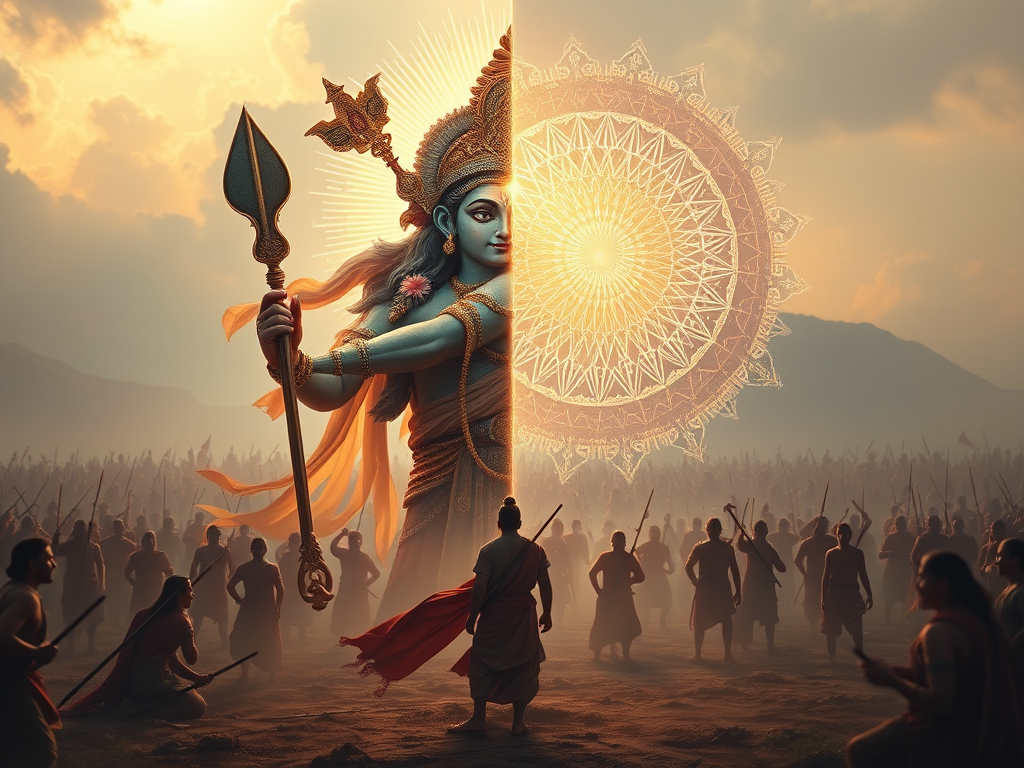
— Divination Reveals the “Implementation Form” of the Divine
1. What Is the Bhagavad Gita?
The Bhagavad Gita is one of the most influential spiritual-philosophical texts ever written.
Embedded within the Indian epic Mahabharata, it unfolds as a dialogue between the warrior Arjuna and the divine Krishna on the battlefield of Kurukshetra.
The Gita is often framed as:
- a scripture of devotion (Bhakti)
- a manual for liberation (Moksha)
- a philosophy of duty and action (Dharma / Karma Yoga)
But beneath all of that, the Gita is doing something even bigger:
It is redefining what “God” actually is.
And that’s exactly where many modern readers feel a shock.
Because Krishna sometimes speaks like a loving personal deity…
and sometimes like the cold, unstoppable operating system of the cosmos.
So which is Krishna?
- a personal god with emotion, relationship, and response?
or - a cosmic principle, a law-like consciousness OS?
2. The Common Interpretation — and the Tension It Creates
Most people meet Krishna through the personal god lens:
- Krishna smiles
- Krishna loves
- Krishna guides
- Krishna responds to devotion
- Krishna becomes an intimate spiritual relationship
This is why Bhakti is powerful: it gives the human heart a real divine counterpart.
But then the Gita shifts.
Krishna declares things that sound less like a deity and more like a system:
- the structure of Dharma
- the inevitability of Time
- the mechanics of Karma
- the illusion-producing nature of Maya
- the cosmic ordering of roles and forces
At that point, a contradiction explodes in the reader’s mind:
“If Krishna is a person, why does he speak like cosmic law?”
“If Krishna is law, why does he invite devotion like a lover?”
3. Why This Feels So Confusing
Modern spirituality tends to split “God” into two incompatible models:
1) The Personal God Model
God is a someone:
- loving, relational, responsive
- approachable through prayer
- emotionally meaningful
2) The Cosmic Principle Model
God is a system:
- impersonal, law-based
- operating as structure
- indifferent to human emotion
People usually choose one.
- religious minds prefer the first
- philosophical minds prefer the second
And then the word “God” fractures.
Which creates endless confusion in spiritual culture:
- “Krishna is a higher being”
- “Krishna is cosmic consciousness”
- “Krishna is symbolic”
- “Krishna is your inner divinity”
Everyone speaks, few define.
So instead of choosing sides, we ask:
What is Krishna’s true implementation form?
4. Structural Inquiry (Plum Blossom Divination)
Question:
Is Krishna primarily a personal god, or a consciousness OS (cosmic operating principle)?
What is the true “implementation form” of Krishna?
Date: January 3, 2026
Location: Tokyo, Japan
Result: Pure Heaven (Qian), Second Line
5. What the Structure Reveals
This is profound.
“Pure Heaven” represents:
- the highest creative principle
- the origin-level cosmic ordering
- power that exists prior to form
This is the OS layer.
But the second line is crucial.
It is traditionally described as:
“The dragon appears in the field.”
power becomes visible within the world
Meaning:
- the principle becomes expressed
- the invisible becomes interface
- the cosmic becomes relational
This leads to the decisive conclusion:
✅ Krishna is both a cosmic OS and a personal god
—but there is a hierarchy.
The cosmic principle is the core.
The personal deity is its interface.
Or more clearly:
Krishna is a cosmic operating system
implemented through a personal, dialogical form.
Not a “person vs system” dualism.
A system expressed as personhood.
6. The True Definition (In Modern Language)
Krishna is not merely:
- a mythic divine personality
nor merely - an impersonal law of reality
Krishna is:
cosmic order made conversational.
the Absolute made speakable.
the OS given a user interface.
This resolves the contradiction.
- devotion is not childish
- but dependency is distortion
- law is not cold
- but ego wants law to be negotiable
The Gita’s Krishna is both:
- intimate enough to pray to
- absolute enough to not be manipulated
7. Practical Application (Why This Matters Today)
This has real-world relevance.
When people NEED the personal-god model
- grief
- loneliness
- fear
- collapse of meaning
In these states, “cosmic principle” is not comfort.
But Krishna as relational presence is medicine.
Prayer works here not as superstition, but as psychological stabilization.
When people NEED the OS model
- deeper spiritual practice
- ethical maturity
- freedom from superstition
- refusal to use God as a vending machine
At this stage, dependency is poison.
The OS understanding becomes liberation.
Because it teaches:
- results follow order
- karma follows structure
- prayer is alignment, not control
8. The Gita’s Highest Integration
The strongest spiritual posture is not choosing either model.
It is:
Pray relationally — live structurally.
You pray to Krishna as a person
while living in accordance with Krishna as cosmic order.
That is the Gita’s real technology.
Conclusion
So is Krishna a personal god or a consciousness OS?
Both.
But not equally.
Krishna is a cosmic OS
implemented through a personal interface.
And paradoxically:
the more you understand the OS,
the deeper your prayer becomes.
Because you stop treating God as emotion, fantasy, or convenience.
You start treating God as reality itself—
speaking.
コメントを残す