The Question of History
Introduction: What Is the Bhagavad Gita?
The Bhagavad Gita is a philosophical dialogue embedded within the Indian epic Mahabharata.
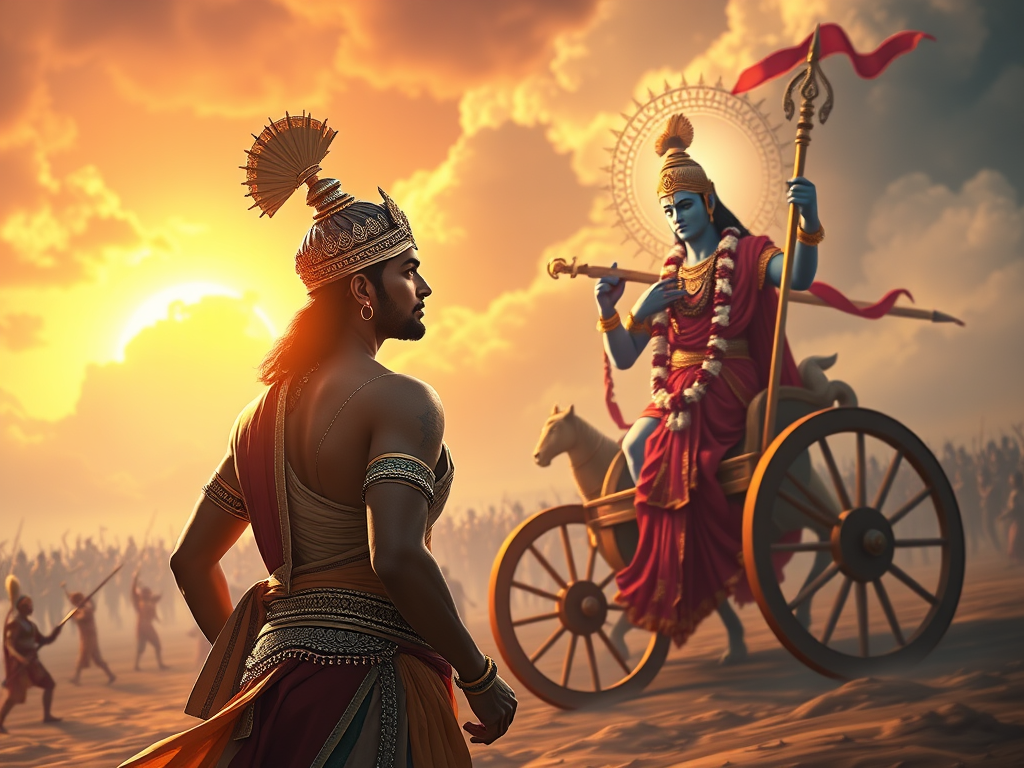
On the battlefield of Kurukshetra, Prince Arjuna hesitates to fight.
Krishna — his divine charioteer — responds with teachings about:
- Dharma (cosmic order)
- Karma (action and consequence)
- The eternal Self
- Liberation (moksha)
While the Gita is often read as a spiritual or ethical text, it also implies a view of time and history.
Does it assume humanity is progressing forward?
Or does it see existence as endlessly repeating cycles?
This is not a minor question.
It shapes how we understand civilization, morality, and destiny.
Casting the Question in Plum Blossom Divination
The inquiry posed:
“Is the Gita grounded in a philosophy of progress or cyclical history?”
Using Meihua Yishu (Plum Blossom Divination), the result was:
Primary Hexagram: Thunder over Heaven — Da Zhuang (Great Power)
Changing Line: Top Line
Resulting Hexagram: Lake over Heaven — Guai (Breakthrough / Resolution)
This progression suggests something more complex than either simple progress or simple repetition.
I. Da Zhuang — Expansion and Power
Da Zhuang represents strong upward expansion.
Growth.
Force.
Momentum.
Accumulation of power.
It resembles the modern idea of progress:
- Technological advancement
- Scientific development
- Political evolution
- Expanding capacity
Civilizations grow stronger.
Knowledge accumulates.
Influence expands.
At first glance, this looks like linear progress.
II. The Top Line — Collision at the Peak
However, the top line of Da Zhuang warns:
When power reaches its extreme, it collides.
Expansion eventually hits a boundary.
History repeatedly shows this pattern:
- Empires rise.
- They overextend.
- They fracture.
Growth does not continue indefinitely.
At its peak, strength turns brittle.
Progress reaches a limit.
III. Guai — The Moment of Decision
The resulting hexagram, Guai, means “breakthrough” or “decisive separation.”
This is not passive decline.
It is a turning point.
A conscious decision is required.
The movement suggests:
Expansion → Excess → Crisis → Resolution.
This is not a simple circle.
It is a spiral.
History does not merely repeat.
It transforms at points of rupture.
IV. The Gita’s View of Time
The Gita explicitly refers to cyclical ages (yugas):
- Golden age
- Declining age
- Dark age
Cosmic time rotates.
Creation and dissolution alternate.
In this sense, the Gita clearly embraces cyclical cosmology.
Yet at the same time, it teaches that the individual can attain liberation — stepping outside the cycle.
This introduces a crucial distinction:
Civilization may move cyclically.
Consciousness can move vertically.
V. The Modern Myth of Progress
Modern Western thought often assumes:
- History improves.
- Human rights expand.
- Science advances permanently.
But war, corruption, and moral collapse continue.
Da Zhuang’s top line reminds us:
Power without restraint leads to collision.
Progress without wisdom self-destructs.
VI. The Risk of Pure Cyclical Thinking
Yet purely cyclical thinking has its own danger.
If everything repeats endlessly,
why strive?
Fatalism emerges.
Guai counters this by emphasizing decisive intervention.
History is not automatic.
Turning points demand action.
Final Conclusion
Plum Blossom Divination suggests:
The Gita is neither purely progressive nor purely cyclical.
It implies a spiral model of history.
Civilizations expand.
They reach limits.
They collapse or transform.
Meanwhile, individuals may transcend the cycle entirely.
Collective time is circular.
Spiritual awakening is directional.
Closing Reflection
Do you believe humanity is evolving?
Or merely repeating patterns?
The Gita would answer:
The world turns in cycles.
But awakening is a choice.
Expansion without awareness leads to collision.
Decision at the moment of crisis shapes the next turn of the spiral.
History may revolve.
Consciousness need not.
コメントを残す