The Question of Collective Order
Introduction: What Is the Bhagavad Gita?
The Bhagavad Gita is a philosophical dialogue within the ancient Indian epic Mahabharata.
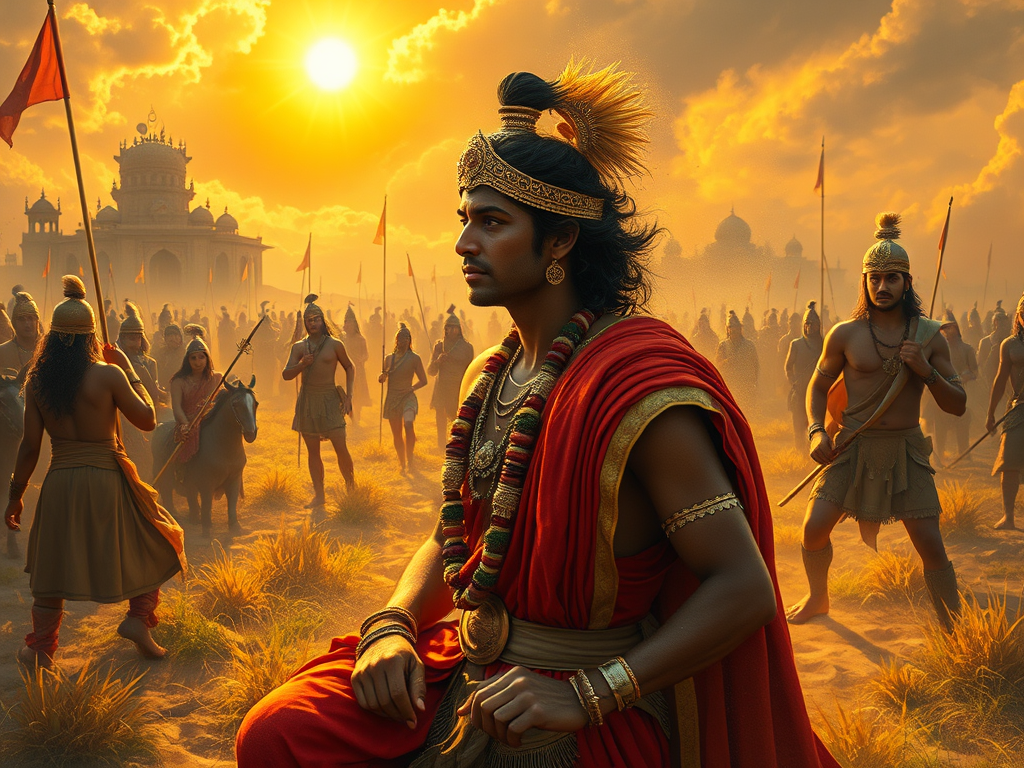
Its setting is a battlefield.
Prince Arjuna, overwhelmed by grief and moral confusion, refuses to fight a war that will destroy his own relatives and teachers. Krishna — his divine guide — responds with teachings about:
- Dharma (cosmic duty)
- Action without attachment
- The immortality of the Self
- Liberation beyond suffering
Yet something feels unsettling.
Arjuna says:
“I do not want this war. I feel sorrow.”
Krishna does not validate his emotional withdrawal.
He instructs him to act.
This raises a modern question:
Does the Gita place collective order above individual happiness?
Casting the Question in Plum Blossom Divination
The inquiry posed:
“Does the Gita prioritize social order over personal happiness?”
The resulting hexagrams were:
Primary Hexagram: Earth over Heaven — Tai (Harmony)
Changing Line: Fourth Line
Resulting Hexagram: Heaven over Earth — Pi (Stagnation / Obstruction)
This progression reveals a tension between alignment and breakdown.
I. Tai — Harmonious Order
Tai represents harmony between above and below.
Heaven and Earth communicate.
The structure is stable.
The system functions smoothly.
Tai is not personal pleasure.
It is systemic equilibrium.
When society operates in alignment, stability emerges.
But stability is not the same as emotional comfort.
Tai reflects collective balance, not private indulgence.
II. The Fourth Line — The Fragile Edge
The fourth line warns against superficial satisfaction.
Temporary comfort may disrupt larger balance.
If individuals pursue short-term gratification without regard for structure,
harmony weakens.
The Gita makes a similar distinction:
Not all forms of happiness are equal.
It describes three types of happiness:
- Sensory pleasure (immediate, fleeting)
- Passion-driven fulfillment (intense but unstable)
- Inner tranquility (stable and enduring)
Krishna privileges the third.
III. Pi — When Order Breaks Down
The resulting hexagram, Pi, means obstruction or disconnection.
Heaven and Earth no longer communicate.
Isolation replaces harmony.
This suggests what happens when alignment collapses.
If individual desire dominates without reference to shared structure,
fragmentation occurs.
Collective breakdown follows.
IV. The Gita’s View of Happiness
The Gita does not reject happiness.
It reframes it.
Arjuna’s immediate emotional relief — avoiding war —
would preserve his personal comfort.
But it would abandon his social role and destabilize the larger order.
The Gita suggests:
Short-term personal comfort
may conflict with long-term structural balance.
True fulfillment arises when action aligns with dharma.
Happiness becomes a byproduct of alignment —
not the primary aim.
V. Is This Collectivism?
From a modern liberal perspective, the text can appear anti-individual.
It does not say:
“Follow your feelings.”
It says:
“Fulfill your role.”
Yet this is not authoritarian collectivism.
The Gita repeatedly emphasizes inner freedom.
Krishna concludes by telling Arjuna:
“Reflect on this fully, then act as you choose.”
Agency remains intact.
The individual is not erased.
But neither is the individual absolute.
VI. The Contemporary Tension
Modern culture often promotes:
- Self-expression
- Emotional authenticity
- Personal fulfillment as highest value
But when individual desire overrides shared structure,
social fragmentation increases.
The Tai-to-Pi movement suggests:
Harmony requires responsibility.
Personal happiness disconnected from order leads to obstruction.
Final Conclusion
Plum Blossom Divination suggests a nuanced answer.
The Gita does not deny individual happiness.
But it does not treat it as supreme.
It prioritizes alignment with dharma —
a larger structural order.
Within that alignment,
a deeper and more stable form of happiness becomes possible.
The question is not:
“Does the Gita reject happiness?”
The real question is:
“What kind of happiness do we mean?”
Immediate comfort?
Or durable harmony?
Closing Reflection
Are you seeking pleasure —
or equilibrium?
The Gita would argue:
Happiness built against structure collapses.
Happiness built within order endures.
The tension between the two
is not easily resolved.
But ignoring the structure does not eliminate it.
And perhaps that is the deeper warning.
コメントを残す