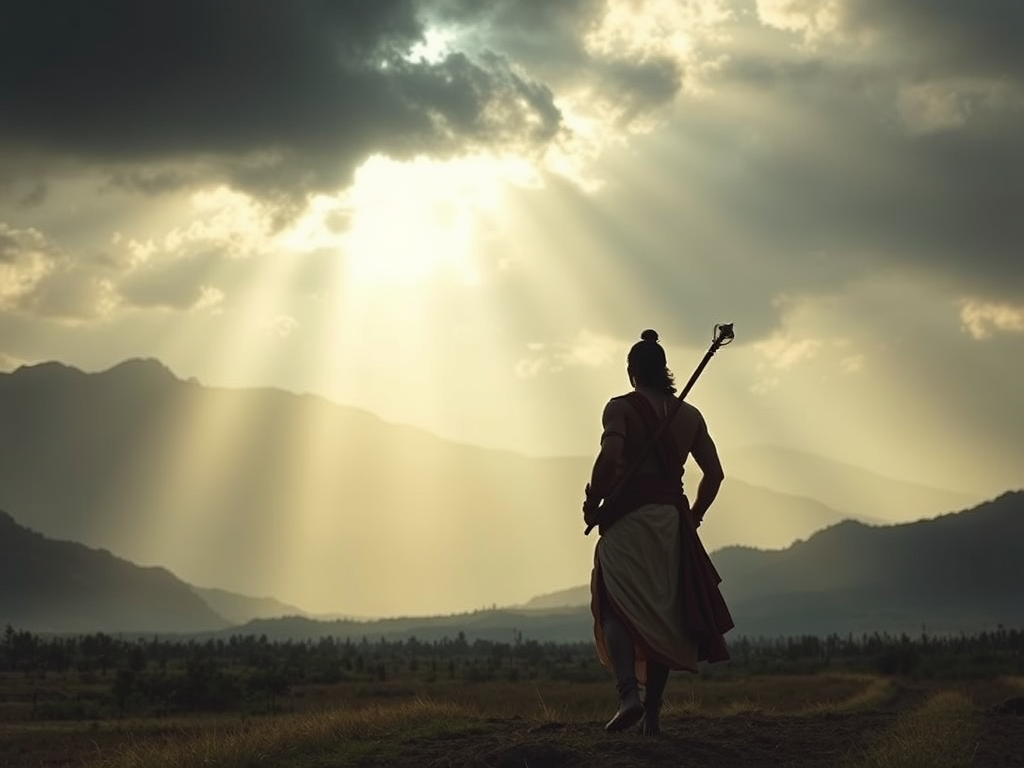
Does It Reject Weakness?
Introduction: “Be Strong” — Is That the Message?
Many readers of the Bhagavad Gita come away with a similar impression:
“Isn’t this just telling us to be mentally strong?”
Krishna speaks to Arjuna, who is overwhelmed on the battlefield, and says:
- Do not be shaken
- Do not grieve
- Stand up and act
In modern language, this sounds like:
“Strengthen your mindset.”
But this raises a deeper question:
Does the Gita dismiss weakness — and only validate the mentally strong?
Consulting Plum Blossom Divination
To explore this question symbolically, we turn to Meihua Yishu (Plum Blossom Divination).
The result:
Primary Hexagram: Water over Mountain — Jian (Obstruction)
Changing Line: Second Line
Resulting Hexagram: Earth over Mountain — Qian (Humility)
This sequence reveals something more nuanced than a simple “be strong” message.
I. Jian — Obstruction and Struggle
Jian represents difficulty.
Blocked movement.
Inner conflict.
Emotional weight.
This is exactly Arjuna’s condition.
And it mirrors many modern experiences:
- anxiety
- confusion
- paralysis
- self-doubt
Importantly, Jian is not condemned.
It is acknowledged.
It is the starting point.
II. The Second Line — Struggle with Meaning
The second line suggests a form of struggle that is not purely personal.
It arises from responsibility.
From tension between inner feeling and outer duty.
This reframes weakness.
Weakness is not failure.
It is often a signal of depth.
A sign that one is confronting something real.
III. Qian — Humility as Strength
The resulting hexagram, Qian, means humility.
Lowering oneself.
Remaining grounded.
Not pushing forward aggressively.
Here, the concept of strength is inverted.
True strength is not dominance.
It is stability without rigidity.
It is resilience without hardness.
IV. What Is “Mental Strength”?
In modern culture, mental strength is often defined as:
- emotional control
- constant positivity
- refusal to show vulnerability
But the Gita presents a different model.
Arjuna breaks down.
He questions everything.
He admits confusion.
And this is where the teaching begins.
V. The Provocative Insight
The Gita does not reject weakness.
But it does not allow stagnation within it.
There is a critical distinction:
Weakness is accepted.
But remaining trapped in it is not.
VI. The Deeper Structure
Jian → Qian
Obstruction → Humility
Struggle → Integration
Transformation happens not by suppressing weakness,
but by passing through it.
Strength is not the absence of struggle.
It is the capacity to move through it without collapse.
Final Conclusion
Plum Blossom Divination suggests:
Jian represents the reality of difficulty.
The second line affirms that struggle has meaning.
Qian reveals that true strength is grounded humility.
The Gita is not a doctrine for the mentally strong.
It is a doctrine of mental transformation.
Closing Reflection
Do you want to be strong?
Or do you want to be unbreakable?
The Gita does not say:
“Never feel pain.”
It says:
“Do not let pain define your action.”
Strength, in this sense, is not hardness.
It is alignment.
And alignment is something even the weakest can begin to cultivate.
コメントを残す