A Reflection Through the Bhagavad Gita and Plum Blossom Divination
Introduction: A Sacred Text Spoken on a Battlefield
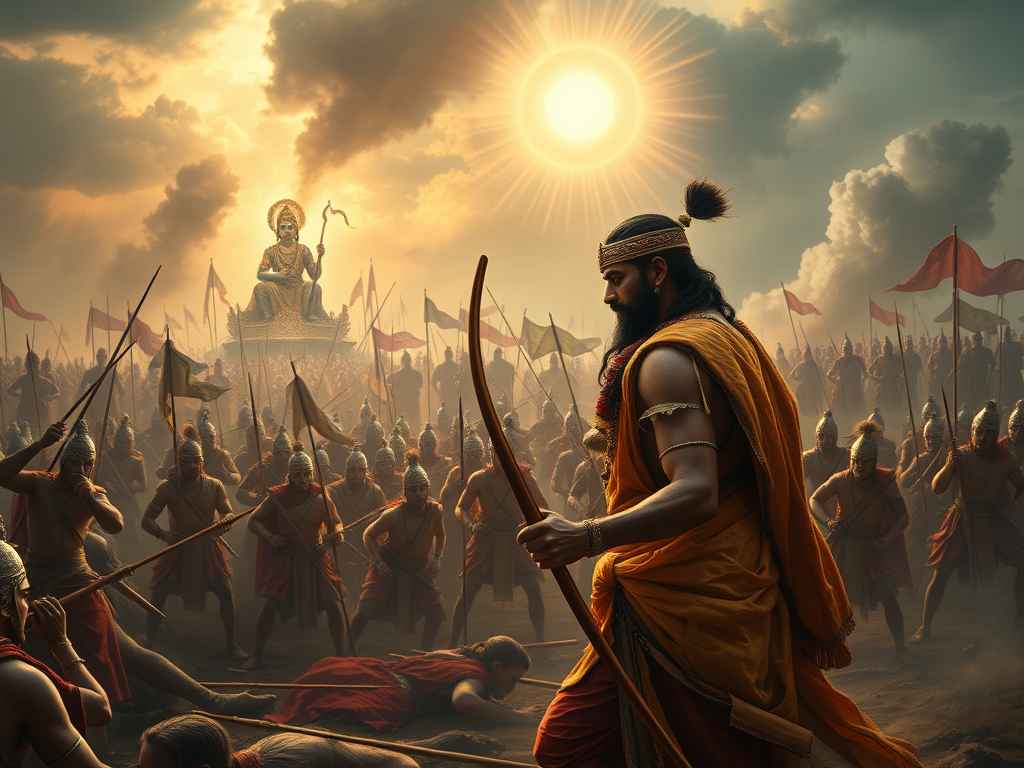
Among the world’s great spiritual texts, the Bhagavad Gita begins in an unusual setting.
Not in a temple.
Not in a monastery.
But on a battlefield.
The field of Kurukshetra.
Two branches of a royal family are about to enter a devastating war.
Prince Arjuna stands between the armies, trembling.
Among the opposing warriors he sees:
- his teachers
- his relatives
- his friends
- even his grandfather
Overwhelmed by grief, he lowers his bow.
He says:
“I will not fight.
What value is victory if it requires the destruction of those I love?”
At that moment, his charioteer — Krishna, an incarnation of the divine — begins to speak.
Yet what Krishna says is surprising.
He does not stop the war.
Instead, he tells Arjuna:
“Fight.”
Even more startling, he declares:
“These warriors are already slain by Me.
You are merely the instrument.”
This leads to a profound and uncomfortable question:
If God exists, why doesn’t God stop war?
Asking the Question Through Plum Blossom Divination
To explore this question symbolically, we can consult Meihua Yishu (Plum Blossom Divination), a classical Chinese system of insight based on the I Ching.
The question posed:
“Why does God not stop war?”
The resulting hexagrams were:
Primary Hexagram: Fire over Water — Wei Ji (Not Yet Completed)
Changing Line: Third Line
Resulting Hexagram: Fire over Wind — Ding (The Cauldron)
This sequence reveals an intriguing pattern.
Wei Ji — The World Is Not Yet Complete
Wei Ji is the final hexagram of the I Ching.
Its meaning is simple yet profound:
“Not yet completed.”
The world is unfinished.
Order is still forming.
Balance has not yet stabilized.
In other words, the universe is not a finished paradise.
It is an ongoing process.
Conflict, chaos, and struggle do not necessarily mean the world is broken.
They may mean the world is still evolving.
The Third Line — The Risk of Premature Completion
The third line of Wei Ji warns:
Acting prematurely brings danger.
Humans often expect divine intervention to instantly correct disorder.
But forcing completion before the process is ready can create greater instability.
Wei Ji suggests that reality unfolds through stages.
The universe may require time, tension, and transformation before equilibrium emerges.
Ding — The Vessel of Transformation
The resulting hexagram, Ding, means “the cauldron.”
In ancient China, a cauldron was used in sacred rituals to transform raw ingredients through fire.
Its symbolism is transformation.
When we look at history, we see that great upheavals have often preceded major transformations:
- collapsing empires
- revolutions
- shifts in political and social structures
This does not mean war is ideal.
But it suggests that profound transformation sometimes arises from periods of intense conflict.
The cauldron does not destroy its contents.
It transforms them.
Two Views of God
The question “Why doesn’t God stop war?” depends largely on how we imagine God.
There are at least two possibilities.
1. God as an Absolute Manager
In this view, God directly controls every event.
If this were the case, one might expect God to prevent war entirely.
2. God as Cosmic Law
In another view, God establishes the fundamental structure of reality — the laws within which freedom operates.
The Krishna of the Bhagavad Gita appears closer to the second model.
He does not micromanage events.
Instead, he restores dharma — cosmic balance — when disorder becomes overwhelming.
The Role of Human Action
One of the most striking aspects of the Gita is that Krishna does not eliminate Arjuna’s responsibility.
He does not say:
“Do nothing. I will handle everything.”
Instead he teaches action.
Human beings must act within the structure of reality.
At the end of the dialogue, Krishna says:
“Reflect on this deeply, and then act as you choose.”
Even in the presence of divine guidance, the decision remains human.
The Real Cause of War
War is rarely the result of divine will.
More often it arises from human forces:
- fear
- ambition
- desire for power
- insecurity
In an unfinished world — a Wei Ji world — human consciousness plays a decisive role in shaping order or chaos.
Final Insight
Plum Blossom Divination suggests the following:
The world is not yet complete (Wei Ji).
And conflict can become a catalyst for transformation (Ding).
God does not necessarily intervene to remove every crisis.
Instead, reality unfolds through processes that include tension, challenge, and change.
Freedom exists.
And with freedom comes both tragedy and possibility.
Closing Reflection
God may not stop wars.
But this may not mean God is absent.
It may mean humanity is participating in the unfinished creation of the world.
The deeper question then becomes:
Will human beings move toward destruction,
or toward transformation?
The answer may depend less on divine intervention —
and more on human awareness.
コメントを残す